
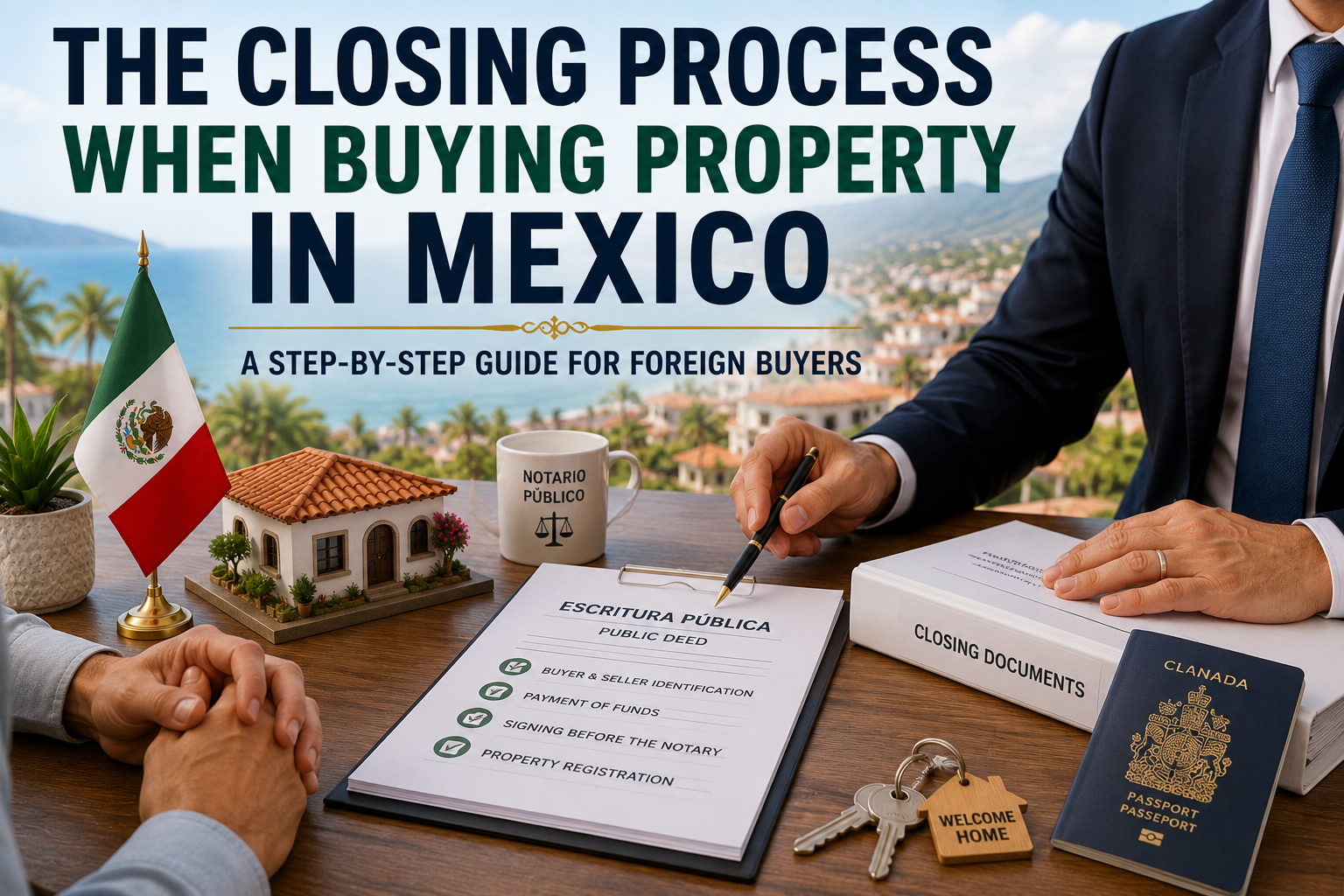
The Mexico real estate closing process can initially seem complicated for Canadian and American buyers. Buying property in Mexico is exciting, but the legal procedures, documents and responsibilities are different from what buyers may be accustomed to in Canada or the United States.
Jim McKinnon, Dream Big In Mexico Real Estate — Bucerías, Nayarit
It doesn’t need to be.
I live and work in Bucerías, Nayarit, and much of my business involves helping Canadian and American buyers purchase property in Bucerías and the surrounding Riviera Nayarit communities. One of the most important parts of my job is making sure my clients understand what is happening from the time we prepare an offer until their purchase is legally completed.
Mexico has a well-established process for transferring real estate, but some of the people involved and their responsibilities are different from what buyers may be accustomed to in Canada or the United States.
The Notario Público plays a central role. Foreign buyers purchasing residential property around Bucerías will also generally require a fideicomiso, or Mexican bank trust, because Bucerías lies within Mexico’s Restricted Zone.
There is also usually a closing coordinator doing a considerable amount of work on the buyer’s behalf behind the scenes.
Once you understand who does what and when it happens, the process becomes much easier to follow.
For buyers who are just beginning to explore the idea, I have also written a more general guide explaining Can Canadians Buy Property in Mexico? and some of the fundamentals foreign buyers should understand before purchasing here.
So, let’s walk through the Mexico real estate closing process step by step, with particular attention to what buyers can expect when purchasing real estate in Bucerías and the surrounding Riviera Nayarit area.
Step 1: Your Offer Is Prepared and Accepted
The Mexico real estate closing process really begins with the purchase offer, so getting this document right is important.
For foreign buyers purchasing Bucerías real estate, the offer will generally be prepared as a bilingual document, with Spanish on the left and English on the right. This makes the agreement much easier for Canadian and American buyers to read and understand.
There is, however, one important distinction buyers should know from the beginning.
The Spanish version is the legally controlling version in Mexico. The English translation is provided as a courtesy to help the foreign buyer understand the agreement, but the English wording itself has no legal bearing in Mexico.
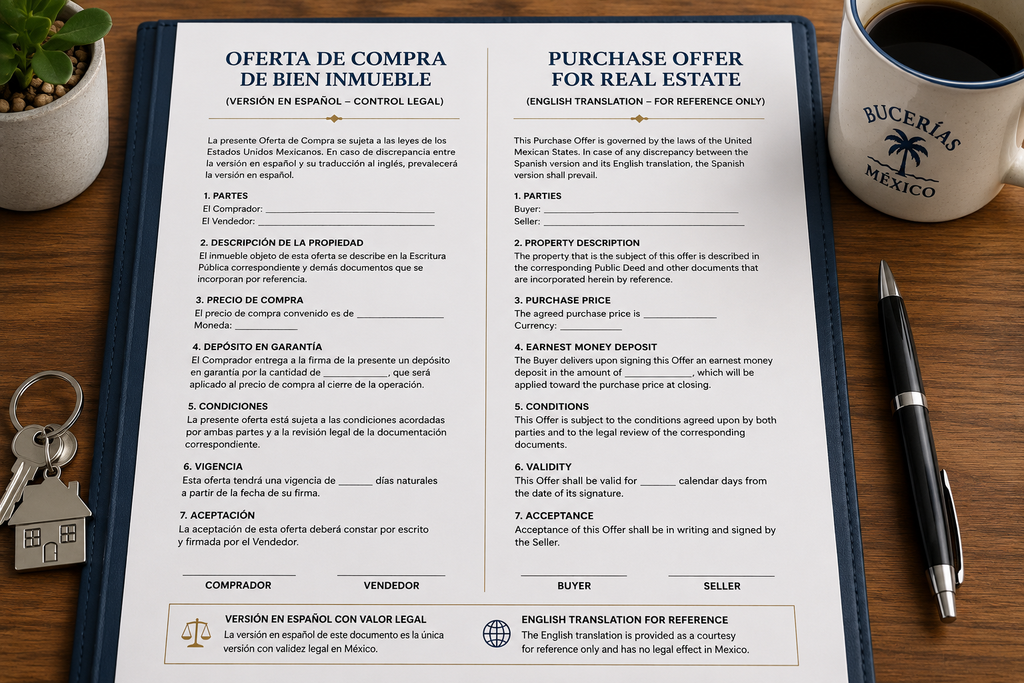
That shouldn’t be concerning. Bilingual agreements are a normal and practical way of handling real estate transactions involving foreign buyers. It simply means that the Spanish wording deserves particular attention.
This is also an area where a good buyer’s agent can provide considerable value.
An experienced buyer’s agent has ways and means of reviewing the bilingual agreement to help ensure that the meaning and intent of the Spanish provisions correspond with the English translation the buyer is relying upon. If there is a discrepancy between the two versions, it should be identified and addressed before the buyer signs the agreement.
I don’t expect my clients to become fluent in legal Spanish just because they want to buy a home in Bucerías.
I do, however, want them to understand what they’re agreeing to.
Before an offer is signed, we normally work through the purchase price, deposit, closing date, inclusions, buyer conditions and any other provisions important to the transaction.
For example, if you’re purchasing a furnished Bucerías condo, the agreement should clearly establish what is included. Furniture, appliances, artwork, electronics and other items can become a source of disagreement if everyone relies on assumptions rather than putting the details in writing.
The same applies to inspections, condominium-document reviews, repairs, deposits, deadlines and other negotiated conditions.
My preference is to deal with these issues at the beginning.
A clearly written bilingual agreement, with the Spanish and English versions conveying the same intent, gives everyone a much better foundation for the closing process that follows.
Step 2: Buyer Conditions and Due Diligence Begin
Once the purchase agreement has been accepted, the buyer moves into the due-diligence period established in the contract.
Depending on the transaction, the buyer’s conditions may include a property inspection, review of condominium documents or other matters specific to the property.
This is an important stage because the buyer is still determining whether the property meets the requirements established in the purchase agreement.
A home or condo can look fantastic during a showing. Due diligence goes deeper.
When buying property in Bucerías, this is particularly important with condominiums. You’re not simply purchasing the space inside your unit. You’re becoming part of a condominium regime with its own rules, expenses and obligations.
The objective is to answer the important questions while the buyer’s contractual conditions are still in place.
Step 3: The Property Inspection Is Completed
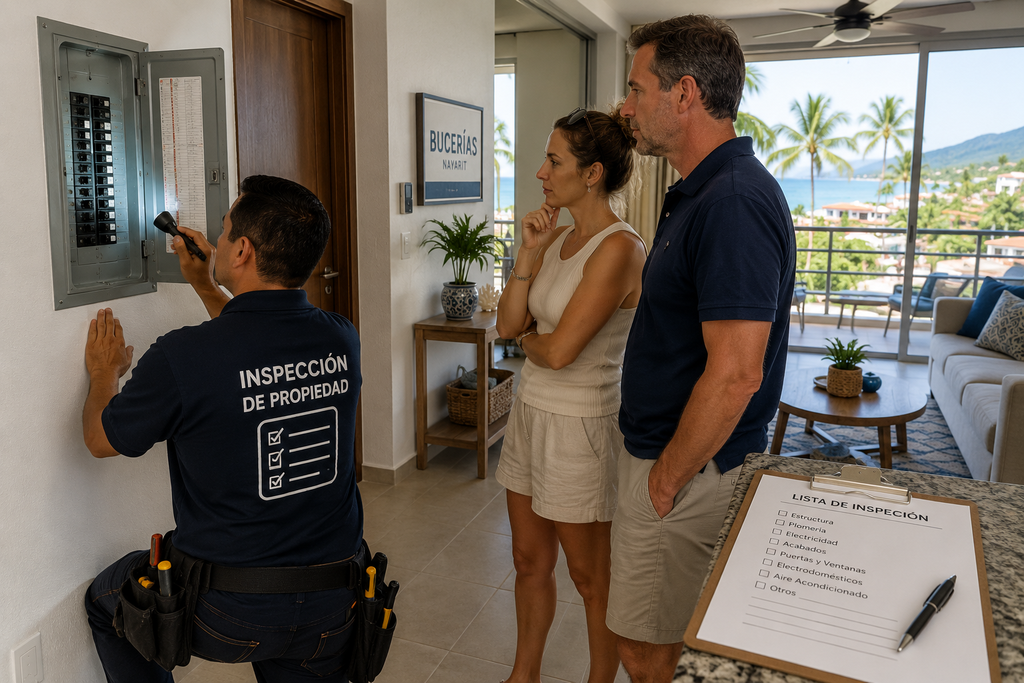
When the purchase agreement includes an inspection condition, the physical inspection normally takes place during the buyer’s conditional period.
A property inspection and a legal review are two different things.
The inspector looks at the physical condition of the property. Depending on the home or condominium, that can include electrical systems, plumbing, air conditioning, appliances, water systems, doors, windows, moisture concerns and other components.
There are also some considerations particularly relevant to Bucerías real estate.
Our climate is different from most of Canada and the northern United States. Heat, humidity, salt air and heavy summer rains can affect buildings and mechanical systems in ways that foreign buyers may not have encountered before.
An inspection doesn’t mean every minor defect needs to become a negotiation.
Its purpose is to give the buyer enough information to make an informed decision before removing the inspection condition.
If something significant is discovered, we deal with it according to the terms of the purchase agreement.
Step 4: Condominium Documents and HOA Information Are Reviewed
A large portion of the Bucerías real estate market consists of condominiums.
If you’re purchasing a condo, reviewing the unit itself is only part of your due diligence.
The condominium documentation should also be reviewed while the appropriate buyer conditions remain in place.
The physical inspection tells you about the unit.
The condominium documentation tells you about the community you’re buying into.
Depending on what is available for the development, buyers should understand the condominium regulations, current maintenance fees, what those fees cover, rental policies, pet restrictions and other rules affecting owners.
Rental rules are particularly important for buyers who intend to generate income from their property.
Pet restrictions can be equally important.
If you’re moving to Bucerías with pets, discovering after the purchase that the condominium has rules affecting them is a problem that should have been avoided during due diligence.
The right condo isn’t simply a property you like. It needs to work for the way you intend to use it.
Step 5: Conditions Are Removed and the Deposit or Escrow Is Funded
Once the buyer’s conditions have been satisfied or removed, the Mexico real estate closing process moves into its next stage: funding the required deposit or escrow.
At this point, the transaction becomes much more firmly committed.
This is also where it’s important to distinguish between a resale property and a pre-construction purchase in Mexico, because the flow of money and even possession can be very different.
Resale Properties
In a typical resale transaction, the purchase agreement establishes the deposit amount, the deadline for funding it and how those funds will be held.
In many Bucerías transactions involving foreign buyers, an independent escrow company is used.
The buyer wires the required deposit to escrow, where the funds are held subject to the purchase agreement and escrow instructions.
The balance of the purchase price is generally funded as the transaction approaches closing.
Wire fraud is a concern in real estate transactions throughout the world. Therefore, buyers should independently verify wiring instructions before sending a substantial amount of money.
I always prefer an extra verification over an expensive assumption.
Pre-Construction Properties
A pre-construction property in Mexico can follow a very different path.
The buyer will often have made a series of contractual payments directly to the developer during construction according to the payment schedule contained in the original purchase agreement.
By the time the formal legal closing occurs, a substantial portion — and sometimes essentially all — of the purchase price may already have changed hands.
In some developments, the buyer may also have taken physical possession of the condominium before the formal deed or fideicomiso closing occurs.
That can seem unusual to Canadian and American buyers because we’re accustomed to thinking of payment, legal closing and possession as events that happen at roughly the same time.
With Mexican pre-construction property, those events can be separated by months.
A buyer may therefore already be living in or using the property while the Notario, bank trustee and closing professionals are still completing the formal transfer.
In that situation, “closing” isn’t necessarily the day you pay for the property or receive the keys. It is the legal completion of a transaction that may have started several years earlier.
Understanding that distinction prevents a lot of confusion.
Step 6: The Closing File Is Opened
Once the buyer has completed the agreed due diligence, removed the applicable conditions and funded the required deposit or escrow, the transaction moves into the formal closing stage.
This is when the closing file is opened.
The detailed work required to complete the legal transfer now begins.
Identification documents need to be assembled. KYC information needs to be provided. Existing title or fideicomiso documentation needs to be obtained. Property records, seller information and documents required by the Notario and trustee bank need to be organized.
From this point forward, the transaction becomes much more administrative and legal in nature.
The buyer’s real estate agent continues to oversee the overall purchase and communicate with the client, while the closing coordinator becomes heavily involved in moving the file toward completion.
Step 7: The Closing Coordinator Takes the Lead on the Closing File
One person foreign buyers may not expect to encounter when buying property in Mexico is the closing coordinator.
In the transactions I handle, the closing coordinator is an extremely important part of the buyer’s side of the transaction.
While I continue overseeing the purchase and communicating with my client, the closing coordinator performs much of the detailed administrative and legal legwork required to move the file toward closing.
The coordinator works closely with the Notario’s office, escrow company, bank trustee when a fideicomiso is involved, the seller’s representatives and other parties involved in the transaction.
Documents need to be gathered.
Names and identification need to be checked.
KYC requirements need to be completed.
Existing deeds or fideicomisos need to be reviewed.
Information needs to be supplied to the Notario.
Trust documentation needs to move through the appropriate bank.
Closing statements and required payments need to be coordinated.
And, inevitably, questions need to be answered.
A good closing coordinator keeps all of those pieces moving and, importantly, works on behalf of the buyer and the buyer’s interests throughout the closing process.
That is different from the role of the Notario Público.
Step 8: The Notario Público and Legal Review
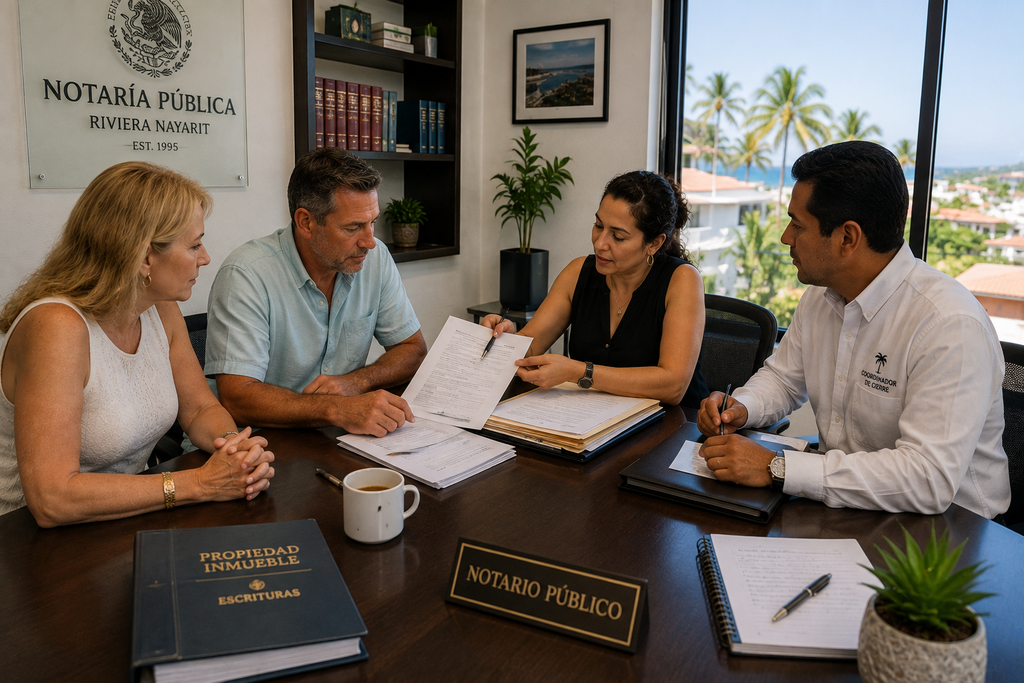
The Notario Público is central to a Mexican real estate closing.
However, a Mexican Notario is considerably different from the notary public most Canadians or Americans are familiar with.
A Notario Público is a highly qualified attorney who has received a government appointment and is authorized to perform specific public legal functions.
The Notario Público therefore plays a formal legal role in the Mexico real estate closing process, but does not act as the buyer’s personal advocate.
In a real estate transaction, the Notario’s office formalizes the transfer and ensures the legal requirements necessary to complete and register the transaction are satisfied.
Importantly, the Notario isn’t simply the buyer’s lawyer.
The Notario performs a public legal function in the transaction and deals with requirements affecting both buyer and seller.
Meanwhile, the buyer’s closing coordinator works with the Notario’s office to supply information, follow up on requirements and help move the buyer’s side of the transaction forward.
I generally explain the relationship to clients this way:
The Notario legally formalizes the transaction. The closing coordinator does much of the legwork required to help get the buyer’s side of the transaction ready to close.
Both roles are important, but they are not the same.
Step 9: Liens, Taxes and Property Documentation Are Verified
Before the transaction can close, the property’s legal status and supporting documentation need to be addressed.
This includes determining whether there are registered liens, encumbrances or other issues that need to be resolved.
Property taxes and other property-related obligations may also need to be confirmed.
If something appears during this process, it doesn’t automatically mean the transaction is in trouble.
Issues can sometimes be corrected or satisfied before closing.
The important thing is identifying them before the legal transfer is completed.
For buyers, much of this work takes place behind the scenes.
You may not see everything the closing coordinator and Notario’s office are doing, but this is a critical part of the Mexico real estate closing process.
Step 10: The Fideicomiso Is Established, Transferred or Cancelled
Because Bucerías is located within Mexico’s Restricted Zone, foreign buyers generally acquire residential property through a fideicomiso, commonly called a Mexican bank trust.
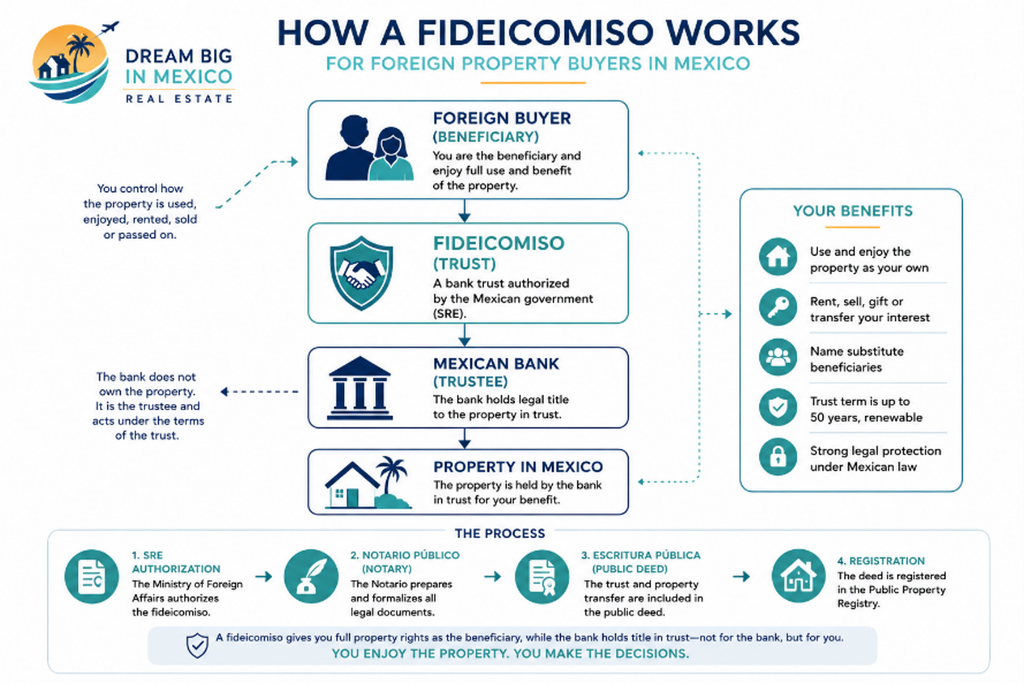
However, not every transaction simply involves establishing a new fideicomiso.
What needs to happen depends partly on how the seller currently holds the property and how the buyer will acquire it.
If the property is currently owned directly and is being purchased by a foreign buyer who requires a fideicomiso, a new fideicomiso may need to be established with a Mexican banking institution acting as trustee.
If the seller is also a foreign owner and already holds the property through a fideicomiso, that existing trust must be dealt with as part of the sale.
Depending on the circumstances and structure of the transaction, this can involve a transfer or assignment of the existing fideicomiso rights, or the cancellation of the seller’s existing fideicomiso and establishment of a new fideicomiso for the buyer.
This can have a significant effect on the closing timeline.
Mexican banks are directly involved in fideicomiso administration, and not every banking institution processes these transactions at the same speed.
In my experience with Bucerías real estate transactions, cancellation of the seller’s existing fideicomiso can sometimes become one of the slower parts of a closing.
Some Mexican banks process cancellation requests relatively efficiently. Others take considerably longer.
That can be frustrating because virtually everything else required for the transaction may be ready while the closing coordinator, Notario, buyer, seller and agents are waiting for the existing trustee bank to complete the documentation necessary to cancel the seller’s fideicomiso.
That doesn’t necessarily mean there is anything wrong with the property.
Sometimes, we’re simply waiting on the bank.
This is one reason I don’t like promising buyers that every Bucerías real estate transaction will close within a specific number of days. Two otherwise similar properties can have very different closing timelines depending on their ownership structure and the banking institutions involved.
The closing coordinator works closely with the Notario’s office, the seller’s existing trustee bank when applicable and the buyer’s trustee bank to keep the process moving and identify delays as early as possible.
The fideicomiso deserves considerably more explanation than I can reasonably fit into one section of a closing article, so I’ve covered the subject separately in How Does a Fideicomiso Work in Mexico?
Step 11: Substitute Beneficiaries Are Confirmed
When a buyer establishes or acquires rights under a fideicomiso, another important consideration is the designation of substitute beneficiaries.
These are the people the buyer designates to receive the beneficial rights under the trust following the buyer’s death, subject to the trust documentation and applicable Mexican law.
For many Canadian and American buyers, this is an important estate-planning consideration.
It deserves some thought rather than simply putting down a name because a form needs to be completed.
Buyers with more complicated family structures, corporations or significant assets should consider obtaining appropriate Mexican and home-country legal or tax advice about their broader estate planning.
Step 12: Closing Costs Are Finalized
Before the Mexico real estate closing process can be completed, the buyer receives a final breakdown of the closing costs.
Closing costs when buying property in Mexico differ from the expenses buyers may be accustomed to in Canada or the United States.
Depending on the transaction, they can include acquisition taxes, Notario-related expenses, registration costs, certificates, fideicomiso expenses, bank charges, government fees and other transaction-specific costs.
The exact amount depends on the property, purchase price and structure of the transaction.
That’s why I don’t like giving buyers a single dollar figure and suggesting it applies to every purchase.
The better approach is to obtain an estimate based on the specific property you’re buying and then update it as the transaction progresses.
There shouldn’t be a mystery about how much money you need to complete your purchase.
For a more detailed explanation of what these expenses can include and how buyers should budget for them, I’ve covered the subject separately in Closing Costs When Buying Property in Mexico: What Buyers Need to Know.
Step 13: The Seller’s Obligations Are Completed
The seller also has work to do before closing.
Required documentation must be supplied. Outstanding property-related obligations may need to be settled. Contractual commitments need to be completed.
If repairs were agreed to as part of the purchase, those items should also be addressed.
For furnished properties, the agreed inventory matters.
This is where good transaction management becomes valuable.
A real estate closing involves many people completing different tasks on different schedules. If nobody is following those tasks, small issues can become last-minute problems.
I prefer to know what’s outstanding well before closing day.
Step 14: The Final Walk-Through Takes Place
For a resale property, I normally want my buyer to complete a final walk-through before closing whenever practical.
This is an important checkpoint in the Mexico real estate closing process because it gives the buyer an opportunity to confirm the property’s condition before closing.
This isn’t a second home inspection.
Its purpose is to make sure the property is substantially in the condition required by the purchase agreement.
We can confirm that agreed inclusions remain at the property and that any required work has been completed.
If the condo was supposed to include the refrigerator, washer, dryer, furniture and specified artwork, closing day isn’t the ideal time to discover something has disappeared.
Again, good documentation at the offer stage makes this considerably easier.
Pre-construction purchases can be different because the buyer may already have received possession and completed a developer handover or deficiency process before the formal legal closing.
Step 15: The Remaining Purchase Funds Are Sent
For a typical resale transaction, the buyer will receive instructions as closing approaches for sending the remaining funds required to complete the purchase.
The exact timing depends on the transaction and escrow arrangements.
International wire transfers can take time.
Banks may also impose daily limits, additional verification procedures or require a client to attend a branch before releasing a large international transfer.
Talk to your bank early.
I have seen buyers discover shortly before closing that their bank won’t allow them to send the necessary amount through online banking.
That’s an avoidable problem.
With pre-construction property, this step may look very different because much or all of the purchase price may already have been paid to the developer.
Step 16: The Closing Documents Are Prepared
As the file progresses, the Notario and closing professionals prepare the documents necessary to formalize the transaction.
Names and personal information need to be correct.
Property descriptions need to correspond with the legal records.
Fideicomiso information must be incorporated when applicable.
The closing coordinator continues working with the buyer and Notario’s office to make sure outstanding buyer requirements are addressed.
Foreign buyers should also remember that the governing legal documents will be in Spanish.
If you don’t speak Spanish fluently, make sure you understand what you’re signing.
Ask questions.
There is nothing wrong with requesting an explanation or obtaining independent legal advice if you want it.
Buying a property is too important to sign documents you don’t understand.
Step 17: Everyone Meets for the Closing
Eventually, we arrive at the day everyone has been working toward.
Closing day.
One thing foreign buyers sometimes find interesting about a real estate closing in Bucerías is how personal the actual meeting can be.
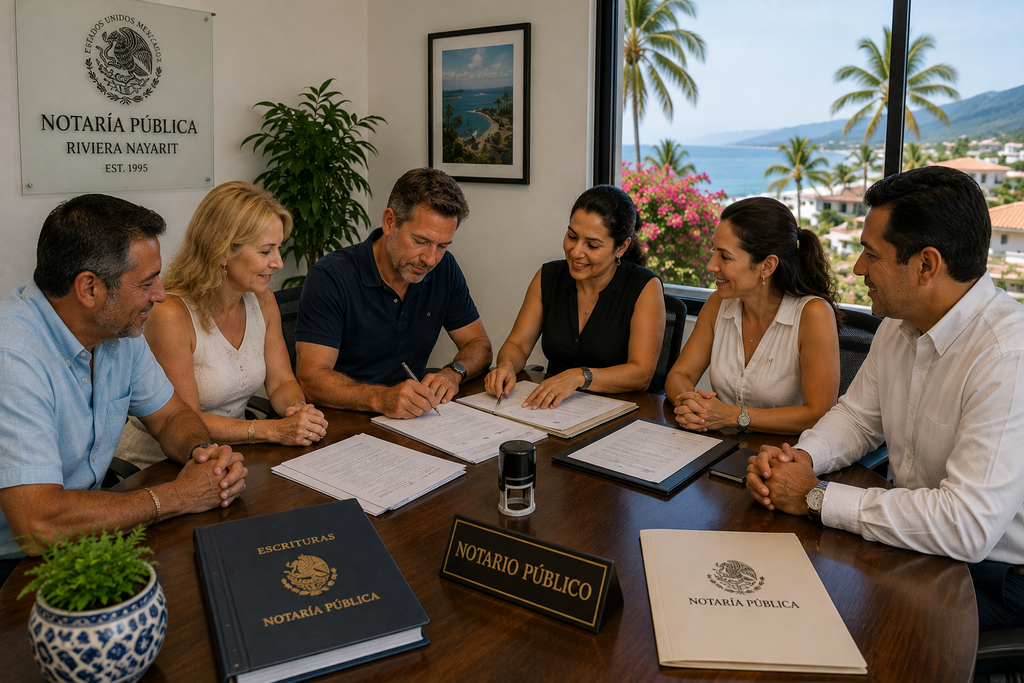
It is quite common for the buyer, seller, buyer’s real estate agent, seller’s real estate agent and closing coordinator to all be together in the same meeting room for the closing.
The Notario or members of the Notario’s office complete the formal signing process and oversee the documents that need to be executed.
When a fideicomiso is involved, the appropriate trust documentation forms part of the legal closing process.
Of course, circumstances vary. A party may sometimes be represented through a properly prepared power of attorney or another legally acceptable arrangement when physical attendance isn’t possible.
However, when everyone is available, it’s quite normal for the principal participants to sit around the same table and complete the transaction together.
Canadian and American buyers sometimes find this different from what they’re accustomed to back home.
You’re not necessarily sitting in your lawyer’s office while the seller is somewhere else with another lawyer.
Instead, many of the people who have been working on the transaction may be sitting together while the purchase is formally completed.
By this stage, there shouldn’t be major surprises.
The buyer’s due diligence has been completed.
The conditions have been removed.
The deposit was funded.
The property documentation has been reviewed.
The fideicomiso requirements have been addressed.
Funding has been coordinated.
The final walk-through has taken place where applicable.
Closing day should be the culmination of the process rather than the day problems are discovered.
When the closing meeting feels almost uneventful, that’s usually a good sign.
It means the work was done beforehand.
Step 18: Funds Are Released Where Applicable
In a resale transaction using escrow, once the required closing conditions have been satisfied, funds can be released according to the applicable escrow and closing instructions.
The seller receives the appropriate proceeds, subject to the deductions, taxes, commissions and other obligations associated with the transaction.
For the buyer, this is one of the benefits of having a properly coordinated closing process.
The legal transfer and movement of money don’t simply happen independently of one another.
They form part of a coordinated transaction.
Again, pre-construction can be different because the developer may already have received most or all of the purchase funds well before the formal closing.
Step 19: Possession and the Keys
For a resale transaction, this is everyone’s favourite step.
You get the keys.
Possession should occur according to the terms of the purchase agreement and closing arrangements.
Then the practical side of ownership begins.
Utilities may need to be transferred or updated. The condominium administration needs your contact information. Access cards, remotes, parking information and other items should be turned over.
If you plan to rent the property, property-management arrangements may need to begin.
If you’re moving to Bucerías permanently, the list can be considerably longer.
For a pre-construction purchase, however, don’t assume that receiving the keys and completing the legal closing will necessarily happen on the same day.
As discussed earlier, some buyers will already have possession of their property before the formal fideicomiso and Notario closing is completed.
That’s another reason it’s important to understand the structure of your particular transaction rather than expecting every Mexican real estate purchase to follow exactly the same timeline.
Step 20: Registration Continues After Closing
Another point sometimes surprises foreign buyers.
Signing the closing documents doesn’t mean every administrative step is instantly finished.
The transaction documentation still needs to proceed through the appropriate registration process.
The Notario’s office handles the legal formalities associated with recording the transaction.
Therefore, buyers shouldn’t be concerned simply because their final registered documentation isn’t handed to them immediately after the closing meeting.
The Mexico real estate closing process does not necessarily end when the documents are signed, because some post-closing administrative steps still need to be completed.
Your closing coordinator can continue to follow the file and keep you informed as the remaining documentation works its way through the process.
How Long Does the Mexico Real Estate Closing Process Take?
There isn’t one answer, and I would be cautious of anyone who suggests otherwise.
The timeline depends on the property, the parties, the documentation, the ownership structure, the fideicomiso, the banks involved and the complexity of the transaction.
A straightforward resale property with organized documentation may move efficiently.
A transaction involving missing documentation or an existing fideicomiso that needs to be cancelled may take considerably longer.
The bank holding the seller’s existing fideicomiso can be a particularly important variable.
Sometimes virtually everything required to close is ready and we’re waiting for one banking institution to complete its part of the process.
Pre-construction has its own timeline because payment, possession and legal closing may happen at completely different times.
I encourage my clients to focus less on an arbitrary number of days and more on making sure the transaction is completed properly.
If you need possession or closing by a particular date, tell your real estate agent at the beginning.
That’s particularly important if you’re coordinating flights, moving arrangements or the sale of another property.
What Can Delay the Mexico Real Estate Closing Process?
Most closing delays aren’t dramatic.
Quite often, they’re administrative.
A missing signature, incomplete KYC information, incorrect name, outstanding certificate, bank requirement or international wire can slow down an otherwise straightforward transaction.
Understanding these potential delays is an important part of navigating the Mexico real estate closing process successfully.
The fideicomiso process can also affect timing substantially.
In particular, cancelling an existing fideicomiso can take longer than expected depending on the Mexican bank currently acting as trustee.
The best defence is organization and communication.
Respond quickly when your closing coordinator requests documentation. Check the spelling of your name and passport information carefully. Speak with your bank well before you need to transfer funds.
Most importantly, work with people who communicate with one another and keep track of what’s still outstanding.
Why Buyer Representation Matters in Bucerías
Finding a beautiful property is only the beginning of buying real estate in Bucerías.
Much of the work in the Mexico real estate closing process happens after the offer has been accepted.
There are conditions to manage, inspections to coordinate, condominium documents to review, deposits to fund, KYC requirements to satisfy, legal documents to assemble, closing costs to review, fideicomiso issues to address and numerous smaller details that need attention.
That’s one reason I’ve chosen to focus on representing buyers.
Before moving to Mexico, I spent decades working in real estate, finance and construction in Canada. That background influences how I approach a property purchase here.
I like understanding the transaction.
I want to know where we are in the process, what’s outstanding, who is responsible for it and what needs to happen next.
More importantly, I want my clients to understand those things too.
That doesn’t mean the real estate agent should try to be the lawyer, Notario, inspector or closing coordinator.
Quite the opposite.
Part of good buyer representation is knowing when you need other professionals and making sure the right people are involved.
That buyer-first approach is also the philosophy behind Dream Big In Mexico Real Estate. My role isn’t to convince somebody to buy a particular property. It’s to represent my buyer throughout the transaction, help coordinate the process and make sure my client has the information needed to make good decisions.
You shouldn’t feel as though your purchase disappears into a mysterious Mexican legal system the moment your offer is accepted.
You should know what’s happening and why.
Buying Property in Bucerías Should Be Exciting
There is something pretty special about getting the keys to a home in Bucerías.
Maybe it’s a condo you’ll use for a few months every winter.
Maybe it’s an investment property.
Maybe you’re buying pre-construction and have been watching your future home rise out of the ground for the past two years.
Or maybe, like many of us who eventually made this area home, you started coming to Mexico for vacations and one day realized you didn’t really want to leave.
Whatever brings you here, the objective is the same.
Find the right property, understand what you’re buying, structure the purchase properly and get it closed.
The Mexico real estate closing process has more moving parts than many foreign buyers expect. However, it becomes much less intimidating when somebody explains those parts and helps you work through them one at a time.
If you’re still deciding where you want to buy, it is also worth spending some time comparing Bucerías and the other communities around the Bay of Banderas. The differences in walkability, beach access, development, rental potential and overall lifestyle can be substantial from one community to another.
If you’re considering buying property in Bucerías, Nuevo Nayarit, La Cruz de Huanacaxtle or elsewhere in Riviera Nayarit, I’m always happy to talk through the process before you start looking at properties.
Sometimes the best way to begin a property search isn’t by looking at listings.
It’s by understanding exactly what will happen when you find the right one.
Jim McKinnon
Dream Big In Mexico Real Estate
Bucerías, Nayarit, Mexico
This article provides general educational information about purchasing real estate in Mexico and should not be considered legal, tax, immigration or financial advice. Mexican laws, government fees, tax rules and administrative procedures can change. Buyers should obtain advice from appropriately qualified professionals regarding their specific transaction.