By Jim McKinnon, Dream Big In Mexico Real Estate — Bucerías, Nayarit
If you are thinking about buying a home or condo in Bucerías, Nuevo Nayarit, La Cruz de Huanacaxtle, Puerto Vallarta or elsewhere around Banderas Bay, understanding closing costs in Mexico is one of the first things I encourage you to do before becoming too focused on the price of the property:
Your purchase price is not your total cost.
That sounds obvious, but closing costs in Mexico real estate transactions can surprise Canadian and American buyers because the system here works differently than what many of us are accustomed to north of the border.
The good news is that these costs aren’t mysterious once you understand what they are and why they exist.
When I’m initially helping someone establish a realistic purchasing budget, I generally suggest using a rule of thumb of approximately 4% to 7% of the purchase price for buyer closing costs, over and above the purchase price.
That doesn’t mean your closing costs will necessarily be 4%, 5%, 6% or 7%. They could fall outside that range depending upon the property and transaction.
It’s a budgeting tool, not a closing-cost quotation.
And that’s an important distinction.
Once we have an accepted offer, one of the things I want to see relatively early in the process is a transaction-specific closing-cost estimate from the closing professionals handling the transaction. At that point, we can replace the rule of thumb with much better numbers.
Understanding that distinction can prevent one of the most avoidable mistakes when buying property in Mexico: spending your entire budget on the purchase price and forgetting about the money required to actually complete the purchase.
So let’s walk through what those costs are, why they exist, and what buyers looking at Bucerías real estate should expect.
How Much Are Closing Costs When Buying Property in Mexico?

For buyers in the Bucerías and Banderas Bay area, I generally recommend initially budgeting for closing costs in Mexico at approximately:
4% to 7% above the purchase price
Again, that’s a planning range — not a guarantee.
If you’re purchasing a $300,000 USD property, for example, using that rule of thumb would mean reserving approximately another $12,000 to $21,000 USD for closing costs.
On a $500,000 USD purchase, the same budgeting approach would mean approximately $20,000 to $35,000 USD.
Those numbers aren’t intended to tell you what your actual closing costs will be.
They’re intended to prevent you from making this mistake:
“My budget is $400,000, so let’s look at properties up to $400,000.”
If $400,000 represents all of the money you’ve allocated to the purchase, we probably shouldn’t be shopping for a $400,000 property.
That’s one of the reasons I like discussing the cost to buy property in Mexico before we start seriously looking at individual homes.
I’d much rather have that conversation at the beginning than after someone has fallen in love with a property.
Why Can’t You Just Calculate Closing Costs as a Percentage?

This is probably the most important thing to understand about Bucerías closing costs.
Not every closing expense is calculated as a percentage of the purchase price.
Some expenses are percentage-based or value-based.
Others are fixed or relatively fixed administrative charges.
Others depend upon whether a new fideicomiso needs to be established or an existing trust can be assigned.
There may be appraisal expenses, government permits, registration costs, certificates, professional fees and banking expenses.
That’s why lower-priced properties can sometimes have closing costs representing a surprisingly high percentage of their purchase price.
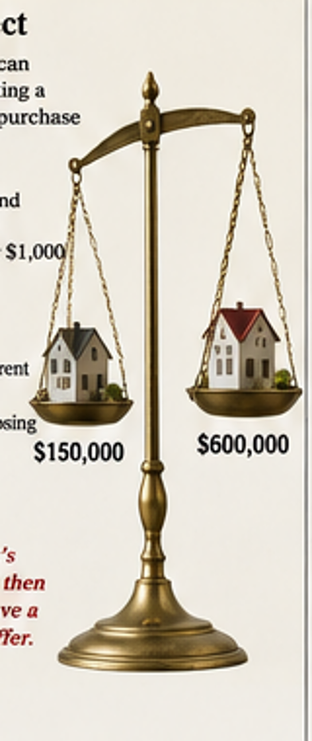
Imagine two buyers.
One purchases a $150,000 property and another purchases a $600,000 property.
If both transactions contain a particular $1,000 fixed expense, that cost represents:
0.67% of the $150,000 purchase
0.17% of the $600,000 purchase
It’s the same expense, but it has a very different effect on the closing-cost percentage.
That’s why I don’t like telling buyers, “Closing costs are X percent.”
They aren’t.
I prefer saying:
For initial budgeting purposes, let’s allow approximately 4% to 7%, and then obtain a proper estimate once we have a specific property and an accepted offer.
That is much more useful.
What Exactly Are You Paying for When Buying Property in Mexico?
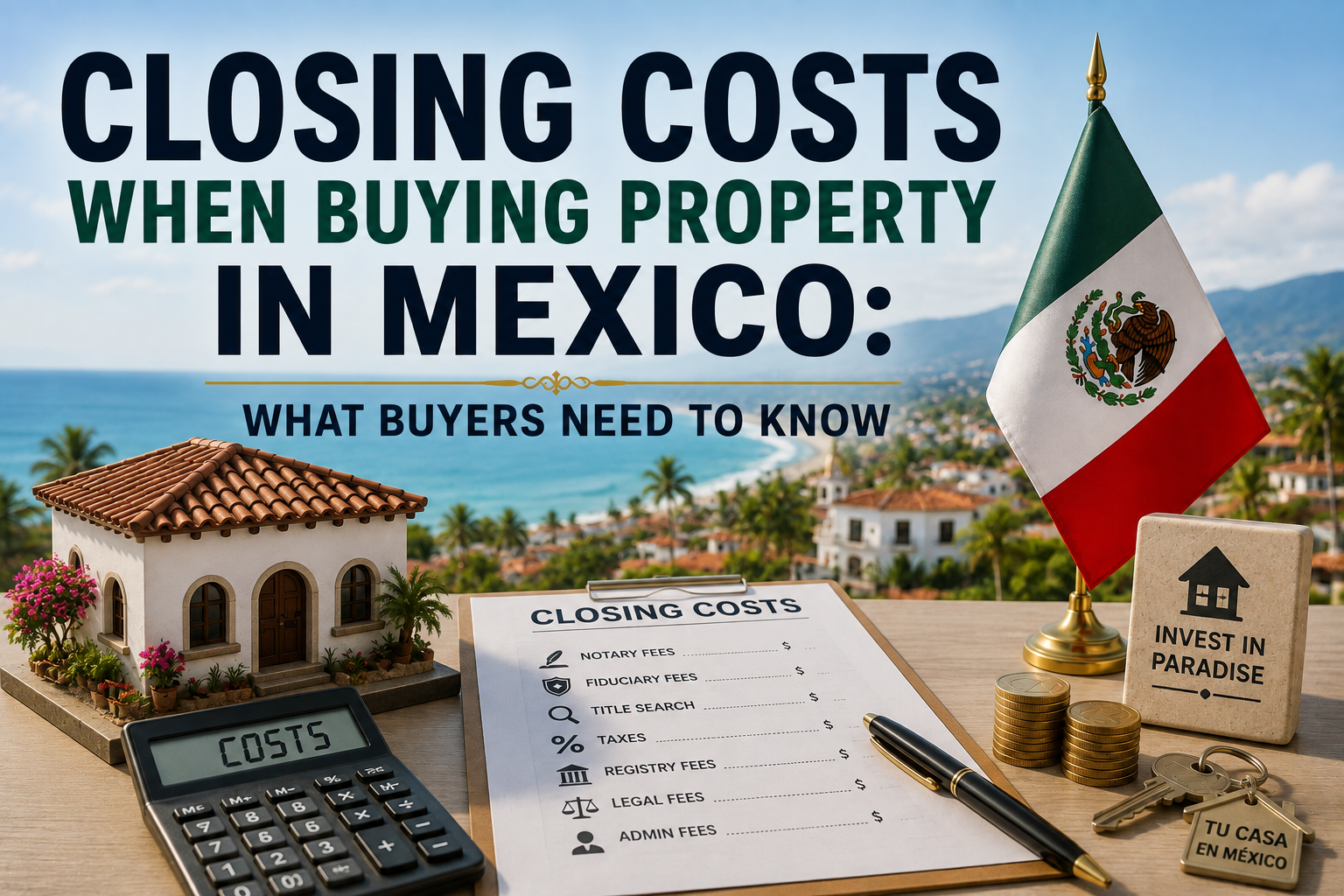
Closing costs in Mexico aren’t simply one large “closing fee.”
They are a collection of taxes, government charges, professional fees and transaction expenses necessary to legally transfer the property and register the buyer’s rights.
Depending upon the transaction, they can include:
Property acquisition or transfer tax
Notario Público fees and expenses
Public Registry fees
Appraisal expenses
Certificates and municipal documentation
Liens and encumbrances searches and registry certificates
Fideicomiso establishment or assignment expenses
Ministry of Foreign Affairs permit expenses where applicable
Bank trustee fees
Escrow-related costs where applicable
Administrative and closing coordination expenses
IVA on taxable professional services
Other property- or transaction-specific charges
Let’s look at the major components individually.
Property Acquisition or Transfer Tax
One of the larger components of closing costs in Mexico is typically the tax associated with acquiring the property.
The terminology and calculation can differ depending upon the state and municipality.
This is particularly relevant in our market because the greater Banderas Bay real estate area crosses a state line.
Bucerías, Nuevo Nayarit, La Cruz and Punta de Mita are in Nayarit.
Puerto Vallarta is in Jalisco.
That’s something buyers don’t always appreciate when they first arrive.
You can drive from Bucerías to Puerto Vallarta relatively quickly, but from a legal and governmental perspective you’ve crossed from one Mexican state into another.
That can affect aspects of the transaction, including how certain taxes and fees are calculated.
For this reason, I would never assume that a closing-cost estimate for a property in Puerto Vallarta should automatically apply to a condo in Bucerías simply because they’re both part of the same general real estate market.
The specific property matters.
The Role of the Notario Público in a Mexican Real Estate Closing
This is another area where Canadians and Americans sometimes get confused.
A Notario Público in Mexico is not equivalent to the type of notary public many people are familiar with in Canada or the United States.
The Mexican Notario Público is a highly qualified attorney who has received a government appointment and plays an important legal role in real estate transactions.
The Notario’s responsibilities can include reviewing the legal status of the property, preparing or formalizing the deed, calculating and collecting applicable taxes, confirming documentation and registering the transaction with the appropriate Public Registry.
The Notario is not simply witnessing signatures.
That’s why the Notario and associated expenses form an important part of closing costs in Mexico.
It is also one of the reasons I encourage buyers not to evaluate a Mexican real estate transaction solely through the lens of how a closing worked when they bought their last house in Calgary, Vancouver, Toronto, Dallas or Denver.
There are similarities.
There are also significant differences.
Understanding which is which makes the process much less intimidating.
Public Registry Fees
Once the transaction is completed, the buyer’s rights need to be properly recorded with the appropriate Public Registry of Property.
Registration is a critical part of the process.
There are fees associated with registering the transaction, and those fees become part of the overall closing costs in Mexico for the buyer.
Most buyers won’t interact directly with the Public Registry themselves.
The Notario and closing professionals handle that part of the transaction.
But it’s still important to understand that some of the money shown on your closing-cost estimate isn’t going to the seller or your real estate agent.
It is paying for the legal and governmental process necessary to properly complete and record your purchase.
Property Appraisal Costs
An official appraisal — commonly referred to as an avalúo — may be required as part of the transaction.
This is not necessarily the same thing as the appraisal Canadians and Americans associate with obtaining a mortgage.
The valuation can have legal and tax significance within the closing process.
The value used for tax purposes may therefore involve considerations beyond simply the negotiated purchase price.
The appraisal itself also has a cost, which forms another component of your overall closing expenses.
Again, this illustrates why accurately calculating closing costs in Mexico requires information about the actual property.
Certificates and Property Documentation
A Mexican real estate closing involves gathering and verifying a substantial amount of documentation.
Depending upon the property, this can include documents concerning:
Property ownership
Property taxes
Municipal accounts
Liens or encumbrances
Condominium obligations
Property identification
Construction
Utilities
Seller information
Other legal or administrative matters
Individual certificates or documents may not represent huge expenses on their own, but collectively they form part of the transaction’s closing costs.
More importantly, the documentation is part of the due diligence process.
When I’m representing a buyer, I’m much more interested in having the transaction properly documented than trying to save a few dollars by eliminating something important.
Buying a home is too significant a transaction to take shortcuts with the paperwork.
Liens and Encumbrances Searches
Another important part of the closing process is confirming whether there are liens, encumbrances or other registered claims against the property.
As part of the legal due diligence involved in a Mexican real estate transaction, the Notario and closing professionals will obtain and review the appropriate documentation from the Public Registry of Property to determine whether the property has registered liens or encumbrances that could affect the transfer of ownership.
Depending on the property and transaction, this could identify issues such as an existing mortgage, registered lien, judicial claim or another recorded restriction affecting the property.
This is an area where I think buyers sometimes look at a line on a closing-cost estimate and see another government or administrative expense without appreciating what they’re actually paying for.
You’re not simply paying to produce another piece of paper.
You’re paying for part of the process that helps establish whether the seller is in a position to transfer the property as contemplated by the purchase agreement and whether registered claims or restrictions need to be addressed before closing.
In practice, documentation commonly associated with this process can include a Certificado de Libertad de Gravamen, or certificate concerning registered encumbrances against the property. The exact documentation and procedures can vary depending upon the jurisdiction and circumstances of the transaction.
If an issue is discovered, that doesn’t automatically mean the purchase can’t proceed. A property may, for example, have an existing mortgage that is intended to be discharged as part of the closing process. What matters is that the issue is identified, properly addressed and documented before the transaction is completed.
For me, this is a good example of why the goal shouldn’t simply be to achieve the lowest possible closing costs.
If I’m helping someone purchase a home in Bucerías, Nuevo Nayarit, La Cruz or elsewhere around Banderas Bay, I want the appropriate due diligence completed. On a purchase involving hundreds of thousands of dollars, verifying the property’s registered legal status is not an area where I would want to save a small amount of money by taking shortcuts.
It is one of the protections built into a properly handled closing and one of the reasons buyers should look at closing costs in Mexico real estate as more than simply an additional expense on top of the purchase price.
Fideicomiso Costs for Foreign Buyers
For Canadian, American and other foreign buyers purchasing residential property around Bucerías and Banderas Bay, the fideicomiso is particularly important.
Much of the area lies within Mexico’s constitutionally defined Restricted Zone.
For residential purchases by foreigners within this zone, ownership rights are commonly held through a Mexican bank trust known as a fideicomiso.
The bank acts as trustee and the buyer becomes the beneficiary of the trust.
As beneficiary, the buyer has extensive rights over the property, including the ability to use it, improve it, rent it, sell it and designate substitute beneficiaries, subject to applicable Mexican law and the terms of the trust.
If you’re purchasing property in Bucerías as a Canadian or American, there is a very good chance the fideicomiso will be part of your transaction.
And those expenses become part of the closing costs in Mexico for foreign buyers.
Establishing a New Fideicomiso
If a new trust needs to be established, there can be costs associated with:
Establishing the trust
Obtaining required governmental authorization
Bank trustee charges
Administrative processing
Related documentation
There is also normally an ongoing annual trustee fee after closing.
The exact amount varies by bank and trust arrangement.
This is why two otherwise similar properties can have somewhat different closing expenses.
One property might already be held within an existing fideicomiso that can potentially be assigned, while another transaction may require a new trust.
The closing professionals need to review the actual circumstances and determine the appropriate structure.
Ministry of Foreign Affairs Permit
When a fideicomiso is being established for a foreign buyer in the Restricted Zone, authorization involving Mexico’s Secretaría de Relaciones Exteriores, or Ministry of Foreign Affairs, is part of the legal structure.
That process creates additional governmental and administrative expenses.
This isn’t some unusual special exception created for a particular buyer.
It’s part of the established legal framework allowing foreigners to acquire rights to residential property in Mexico’s Restricted Zone.
For buyers in Bucerías, Riviera Nayarit and Puerto Vallarta, understanding this structure is important because we’re talking about coastal real estate.
Once you understand why the fideicomiso exists and how it works, it tends to become much less intimidating.
Bank Trustee Fees
A fideicomiso isn’t free to maintain.
The Mexican bank serving as trustee normally charges an annual administration fee.
The amount varies among banks and trusts.
Buyers should distinguish between:
Initial fideicomiso expenses at closing
and
ongoing annual trustee expenses after closing.
They’re related, but they’re not the same thing.
When evaluating the long-term cost of owning property in Mexico, I encourage buyers to consider recurring expenses as well as purchase expenses.
That means thinking about:
Property taxes
Condominium or HOA fees
Fideicomiso trustee fees
Insurance
Utilities
Maintenance
Property management, if required
Those aren’t closing costs, but they’re part of responsible budgeting.
Escrow Expenses
Escrow is commonly used in real estate transactions involving foreign buyers in our market.
Where an independent escrow company or escrow service is used, there may be a fee.
The purpose of escrow is straightforward: funds are held and released according to the contractual terms of the transaction.
Buyers accustomed to North American real estate will probably recognize the concept even though the specific procedures may differ.
The important thing is to understand:
Where is my money going?
Who is holding it?
Under what conditions can it be released?
Those are questions worth asking in any real estate transaction, regardless of country.
IVA on Professional Services
Another item Canadians and Americans sometimes overlook is Mexico’s value-added tax, IVA.
IVA may apply to taxable professional services involved in the transaction.
As a result, when you’re reviewing an estimate or quotation, make sure you understand whether IVA is already included or will be added.
A professional fee and a professional fee plus IVA aren’t the same number.
It’s a relatively simple point, but it can make a difference when several professional services are involved.
Are Real Estate Commissions Part of the Buyer’s Closing Costs?
Generally, in the traditional resale transaction structure in our market, real estate commissions are typically an obligation of the seller under the listing agreement rather than an additional buyer closing cost.
However, buyers should never assume this without reviewing the actual transaction documents.
The offer and purchase agreement ultimately determine the contractual obligations of the parties.
One of my general rules in real estate is:
If money is involved, don’t rely on assumptions. Read the agreement.
Why Are Closing Costs in Mexico Higher Than Some Buyers Expect?
I sometimes hear buyers compare Mexican closing costs with what they paid to purchase a home in Canada or the United States.
That’s understandable, but it isn’t always a useful comparison.
Mexico has a different system.
You’re potentially combining:
Acquisition taxes
Government charges
Registration
Notario expenses
Appraisal
Certificates
Liens and encumbrances searches
Fideicomiso establishment
Foreign Affairs authorization
Banking expenses
Escrow
IVA
Other administrative expenses
When you understand what’s contained in the total, the number makes considerably more sense.
Why Lower-Priced Properties Can Have Higher Percentage Closing Costs
This deserves repeating because it’s one of the biggest misunderstandings surrounding the cost to buy property in Mexico.
Suppose a buyer purchases a smaller Bucerías condo for $150,000 USD.
Another buyer purchases a $600,000 USD home.
Some transaction costs may be related to value.
But others may be relatively fixed.
Both transactions still require legal documentation.
Both need registration.
Both may require certificates.
Both may require a fideicomiso.
Both may involve administrative expenses.
As a result, the buyer of the $150,000 property could see closing costs representing a larger percentage of the purchase price than the buyer purchasing the $600,000 property.
That’s why I advise people to be particularly cautious about applying percentage rules to lower-priced properties.
A Practical Bucerías Closing-Cost Example
Let’s use a hypothetical example.
A couple from Alberta has decided they want to purchase a condo in Bucerías.
They have $350,000 USD available for the entire purchase.
Initially, they might tell me:
“Our budget is $350,000.”
My next question is essentially:
Does that mean you’re comfortable purchasing a $350,000 property, or does $350,000 represent the total amount of money you want invested by the time the transaction closes?
Those are very different things.
If $350,000 is their total available capital, I wouldn’t begin by showing them properties at $350,000.
Using our preliminary 4%–7% planning range, we need to leave room for closing costs.
There may also be:
Furniture purchases
Immediate improvements
Moving expenses
Insurance
Initial HOA payments
Utility setup
Emergency reserves
Suddenly the appropriate property-search budget may be considerably lower than $350,000.
That’s not bad news.
It’s simply good planning.
When Should You Get an Actual Closing-Cost Estimate?
As early as reasonably possible once you have a specific transaction.
Before we know the property, nobody can provide a truly accurate estimate because several important variables remain unknown.
But once there’s an accepted offer, I want the buyer to receive a transaction-specific estimate from the appropriate closing professional.
That estimate should help answer:
How much money will I actually need to complete this purchase?
At that point, we’re no longer relying simply on a 4%–7% rule of thumb.
We have a property.
We have a purchase price.
We know where the property is located.
We know more about the ownership structure.
We know whether a fideicomiso is involved.
We know much more about the actual transaction.
That’s when the numbers become useful.
Don’t Confuse the Closing-Cost Estimate With the Final Closing Statement
An initial closing-cost estimate is still an estimate.
Some costs can change as the transaction progresses.
The final numbers become clearer as the Notario and closing professionals complete their work.
So I encourage buyers to maintain a reasonable cash cushion rather than arranging their finances so tightly that a relatively small adjustment creates a problem.
I’ve spent much of my professional life around finance, construction and real estate, and one principle applies to all three:
Contingency is cheaper than crisis.
A little financial breathing room makes transactions much easier.
Closing Costs for Pre-Construction Properties in Mexico
Pre-construction deserves special attention because the timing and structure of payments can differ significantly from a resale transaction.
Depending upon the development, buyers may encounter:
Reservation deposits
Contract deposits
Construction-progress payments
Final closing payments
Fideicomiso expenses
Closing expenses
HOA startup or reserve contributions
Utility or service setup charges
The developer may provide projected closing costs, but I would still want to understand exactly what is and isn’t included.
For example:
Does the quoted purchase price include IVA where applicable?
Who pays for establishing the fideicomiso?
Are there additional closing or administrative fees?
Is there an HOA reserve contribution?
Are utility connection fees included?
When are closing costs payable?
Pre-construction contracts can differ substantially between developments.
Don’t assume the terms from one Bucerías development apply to another.
Closing Costs When Buying a Resale Property
With a resale property, the transaction typically involves transferring an existing property from the seller to the buyer.
The closing process may include reviewing:
Existing title or fideicomiso
Property tax status
Condominium status
Liens and encumbrances
Existing debts
Seller documentation
Property documentation
Improvements and construction records
Utility status
Other legal issues
The buyer’s closing costs will then be calculated based upon the specific transaction.
This is one reason I like having an experienced closing coordinator involved.
A good closing isn’t just a date when everyone signs documents.
It’s a process.
Can You Finance Closing Costs in Mexico?
Buyers should generally plan to have sufficient liquidity to cover their closing expenses.
The market in our area remains heavily cash-oriented compared with Canadian and U.S. real estate markets.
Financing options do exist in Mexico, including options for foreign buyers, but the structure, rates, qualification process and costs can differ significantly from what buyers are accustomed to at home.
If your purchase depends upon financing, that should be discussed before you make an offer.
What Currency Are Closing Costs Paid In?
Although many properties in areas such as Bucerías and Puerto Vallarta are marketed with U.S.-dollar reference prices, the legal and financial mechanics of a Mexican transaction ultimately operate within Mexico’s legal and monetary system.
Exchange rates can therefore matter.
If your money is currently held in Canadian dollars and your purchase is being discussed in U.S. dollars while expenses are ultimately calculated or paid in Mexican pesos, currency movement can have a meaningful effect.
That is another reason I don’t recommend running your available cash balance down to the last dollar.
Leave room.
Can Closing Costs Be Negotiated?
Some professional or service fees may vary depending upon the provider and transaction.
Government taxes and statutory charges aren’t simply negotiable because a buyer would prefer to pay less.
More importantly, I don’t think the objective should be:
“How do I make my closing as cheap as possible?”
The better question is:
“How do I make sure my closing is properly handled while paying reasonable and transparent costs?”
You’re buying a significant asset in another country.
This isn’t the place where I want to see someone save a few hundred dollars by eliminating professional work that protects a six-figure investment.
Should You Hire a Lawyer When Buying Property in Mexico?
This is ultimately a buyer decision based upon the transaction and the buyer’s comfort level.
The Notario plays an essential role in the transaction, but the Notario is not necessarily acting as the buyer’s personal attorney in the same way a privately retained lawyer would.
Some buyers choose to retain independent legal counsel, particularly where a transaction is complicated.
If you do, that legal fee should obviously be added to your purchasing budget.
What matters to me is that buyers understand who each professional represents and what their responsibilities are.
Who Calculates the Final Closing Costs?
Your actual transaction costs should be calculated by the appropriate closing professionals and Notario based upon the property and transaction.
Your real estate agent can help you understand the process and establish a sensible preliminary budget.
But I don’t believe an agent should pretend to know the exact final closing costs before the transaction has been properly reviewed.
There’s a difference between experience and overconfidence.
Experience tells me that I should help you plan.
It also tells me when someone else is the appropriate professional to calculate the final number.
Five Questions to Ask About Closing Costs
Before purchasing property in Bucerías or elsewhere around Banderas Bay, I would want answers to these five questions:
1. What is included in my estimated closing costs?
Ask for a breakdown rather than simply accepting a percentage.
2. Does the transaction require a new fideicomiso?
If so, understand the setup costs and future annual trustee fee.
3. Which expenses are estimates and which are already known?
This helps you understand how much contingency you should maintain.
4. When will the closing funds be required?
Knowing that you owe money isn’t enough. You also need to know when it needs to be available.
5. Who is responsible for each expense?
Your purchase agreement should clearly establish the financial obligations of buyer and seller.
Simple questions can prevent complicated problems.
The Real Cost of Buying Property in Bucerías
If you’re trying to establish the cost to buy property in Mexico, don’t stop with the listing price.
Think in terms of your total acquisition budget.
That means:
Purchase price
plus
Closing costs
plus
Immediate post-closing expenses
plus
A reasonable cash reserve
That is the number I think buyers should use when deciding what they can comfortably afford.
For example, if you have $500,000 USD available, buying a $500,000 property may leave you financially stretched.
A $450,000 or $460,000 property with money remaining for closing costs, furnishings and reserves may ultimately be a much more comfortable purchase.
The objective isn’t to buy the most expensive property you can technically afford.
It’s to buy the right property without creating unnecessary financial stress.
Closing Costs Are Part of the Buying Strategy
This is where I think good buyer representation begins long before we’re negotiating an offer.
When someone contacts me about Bucerías real estate, I don’t want our first conversation to simply be:
“What do you want to see?”
I want to understand:
What are you trying to accomplish?
Will this be a full-time home, winter residence, vacation property or rental investment?
What communities fit the lifestyle you’re looking for?
What’s your comfortable purchasing budget?
How much liquidity do you have available?
Have you accounted for closing costs?
Do you understand the fideicomiso?
Are you prepared for the ongoing costs of ownership?
Those questions aren’t nearly as exciting as walking through an ocean-view condo.
But they can be much more important.
Once we’ve established those fundamentals, looking at properties becomes much more productive.
Buying in Bucerías Versus Puerto Vallarta
Another reason local knowledge matters is that “Banderas Bay real estate” isn’t one homogeneous market.
Bucerías and Nuevo Nayarit are in Nayarit.
Puerto Vallarta is in Jalisco.
Different municipalities and states can have different tax structures, administrative procedures and fees.
Property types also vary enormously.
A resale condominium in the Bucerías Golden Zone isn’t the same transaction as a pre-construction condo in Nuevo Nayarit.
A house in a gated community isn’t the same as a beachfront condo.
A $150,000 studio isn’t financially identical to a $1 million villa.
The general principles are the same.
The details aren’t.
My Rule of Thumb for Buyers
If you’re in the very early stages of looking at property around Bucerías, here’s the approach I suggest:
Step 1 — Establish your total available budget
Not simply the maximum property price.
Step 2 — Reserve approximately 4%–7% for preliminary closing-cost planning
Remember that this is only a rule of thumb and lower-priced properties can exceed the range.
Step 3 — Leave money for post-closing expenses
Furniture, insurance, HOA expenses, repairs, improvements and moving costs add up.
Step 4 — Establish the appropriate property-search range
Now we know what properties you should actually be looking at.
Step 5 — Obtain a proper closing-cost estimate after an offer is accepted
Replace the rule of thumb with transaction-specific information.
It’s not complicated.
But doing things in that order can make the entire buying process much smoother.
The Most Important Number Isn’t Always the Purchase Price
Buying property in Mexico should be exciting.
For many of my clients, buying in Bucerías or elsewhere around Banderas Bay represents something they’ve been thinking about for years.
Maybe it’s escaping Canadian winters.
Maybe it’s retirement.
Maybe it’s spending several months each year near the ocean.
Maybe it’s simply wanting a different pace of life.
Whatever the reason, the financial side of the transaction shouldn’t be an afterthought.
Understanding closing costs in Mexico real estate transactions is part of becoming an informed buyer.
For initial planning in our area, I generally use approximately 4%–7% of the purchase price as a reasonable rule of thumb.
But remember what that number is:
A budgeting tool.
It isn’t a quotation.
It isn’t a guarantee.
And it isn’t a substitute for a transaction-specific closing-cost estimate prepared once the actual property and purchase terms are known.
The best time to understand your closing costs isn’t three days before closing.
It’s before you decide how much property you can afford.
If we get that part right at the beginning, everything that follows tends to become considerably easier.
About Jim McKinnon
Jim McKinnon is a real estate professional with Dream Big In Mexico Real Estate, based in Bucerías, Nayarit. After a career spanning real estate, construction and financial planning in Canada, Jim now works with buyers purchasing homes and investment properties in Bucerías, Nuevo Nayarit, La Cruz de Huanacaxtle and surrounding communities around Banderas Bay.
His approach focuses on helping buyers understand not only which property they might want to purchase, but also how the purchasing process in Mexico actually works.
This article is intended for general educational purposes and should not be considered legal, tax or financial advice. Taxes, government fees, banking charges and closing procedures can change and may vary by municipality, property and transaction. Buyers should obtain transaction-specific information from the appropriate Notario Público, closing professional, lawyer, accountant or other qualified professional.