An updated look at Canadians selling U.S. property, the changing Canada-U.S. relationship, and why Bucerías, Nayarit may be the right place for their next winter home.
By Jim McKinnon | Dream Big In Mexico Real Estate
Canadians selling U.S. property has become a much bigger conversation than when I first wrote about this subject in April 2025. At the time, Canadians were only beginning to reconsider whether owning a vacation home in the United States still made sense.
At the time, the idea was fairly straightforward. Donald Trump had returned to the White House, the relationship between Canada and the United States was becoming increasingly uncomfortable, and there were legitimate questions about what changing immigration policies could mean for Canadian snowbirds.
I suggested that Canadians who were already thinking about selling properties in places such as Florida, Arizona and California might want to take a look a little farther south — at Bucerías, Mexico.
A lot has happened since then.
The United States has imposed new tariffs on Canadian goods. Canada is retaliating. Canadian travel to the United States has dropped substantially. Canadians have demonstrably shifted some of their spending away from American products. Canadian interest in buying U.S. real estate has declined.
And now we have actual survey evidence showing that a significant number of Canadian owners of U.S. properties are considering selling them.
I’ve even had this conversation personally. A recent buyer told me they are selling their home in Arizona because of what has been happening between Canada and the United States and are looking at Mexico as an alternative.
Then, just when I thought the relationship couldn’t get much stranger, President Trump signed an executive order directing the U.S. federal government to rename Lake Ontario “Lake America.”
I’m Canadian. I honestly don’t know what to say about that one.
But I do know this:
For Canadians who own winter homes in the United States, this is no longer a hypothetical conversation about what might happen.
The relationship has changed.
And if you’ve already found yourself wondering whether you still want to own a U.S. vacation property, I think it’s reasonable to start asking another question:
If not the United States, where do we want to spend our winters?
For a growing number of Canadians, Mexico deserves serious consideration.
And for Canadians looking at Mexico, I believe Bucerías, Nayarit should be near the top of the list.
Canadians Really Are Pulling Back From the United States
There is a danger when writing about something as politically charged as the current Canada-U.S. relationship of confusing what people say they’re going to do with what they actually do.
Fortunately, we now have data.
Statistics Canada reported that Canadians made close to 10 million fewer trips to the United States in 2025 than in 2024, a decline of approximately 25%.
That wasn’t simply a temporary protest.
During the first quarter of 2026, Canadian residents made 5.5 million trips involving a visit to the United States, down another 10.6% from the same period in 2025.
Canadian spending during those U.S. visits also fell 13.6%, to approximately $5 billion.
But Canadians haven’t stopped travelling.
During that same first quarter of 2026, Canadians made 4.6 million trips involving overseas destinations, an increase of 6.2%.
And the number-one overseas country visited by Canadians?
Mexico — with approximately 1.3 million Canadian visits in just three months.
That’s a pretty significant shift.
Canadians still want sunshine. We still want to get away from February. We still want beaches, golf, restaurants and somewhere warm to spend part of the winter.
We’re just not automatically assuming that the United States is where we have to do it.
Canadians Aren’t Just Changing Their Travel Plans
The shift goes beyond tourism.
There has been a very real “Buy Canadian” movement since the trade relationship deteriorated.
Ipsos found in September 2025 that 56% of Canadians surveyed had recently bought more Canadian products or investments, while 58% reported avoiding American products, services, investments or travel because of the state of Canada-U.S. relations.
Among Baby Boomers — which obviously overlaps heavily with the traditional snowbird demographic — the numbers were even more striking. About 70% reported prioritizing Canadian purchases and 71% reported avoiding American alternatives.
The Bank of Canada subsequently looked beyond polling and examined actual spending data.
Its researchers found evidence that Canadians really had shifted grocery spending away from U.S. products and toward Canadian ones. They also documented the enormous reduction in travel to the United States.
So this isn’t simply people complaining on Facebook.
Canadians are changing where they travel and, at least in some categories, where they spend their money.
And that brings us to real estate.
Are Canadians Actually Selling Their U.S. Properties?
This is where the numbers become particularly relevant to Canadian snowbirds.
Royal LePage commissioned a national survey in August 2025 of 2,500 Canadian adults. Among Canadians who owned residential property in the United States, 54% said they were planning to sell within the following year.
Even more interesting was why.
Among those planning to sell, 62% identified the current U.S. political administration as the primary reason.
Another 33% cited personal or financial reasons, while 5% pointed to increasingly extreme weather events.
That’s an extraordinary number of Canadians selling U.S. property — or at least seriously contemplating an exit.
And there is evidence on the ground as well.
Reuters reported Canadian snowbirds listing properties in traditional destinations such as Florida and Arizona as deteriorating Canada-U.S. relations, the Canadian dollar, insurance costs and immigration concerns caused some longtime owners to reconsider their plans.
I’m starting to see it personally as well.
A recent buyer told me they are selling their home in Arizona because of what has been happening between Canada and the United States. They are now considering Mexico for the next stage of their winter lifestyle.
One client doesn’t establish a real estate trend, and I wouldn’t pretend that it does.
But when I’m hearing the same conversation from an actual buyer in Bucerías that we’re seeing reflected in national surveys, travel statistics and real estate reporting, it’s worth paying attention.
What Happens If More Canadians Sell U.S. Property?
This is something I think Canadians selling U.S. property should at least consider carefully.
I want to be very careful here because nobody can responsibly say that Canadians selling their vacation properties will cause real estate prices across Florida, Arizona or California to fall.
Those markets are far too large and complex for a statement like that.
But real estate is still governed by supply and demand.
If more Canadians selling U.S. property enter the market while fewer Canadians are looking to buy U.S. vacation homes, certain snowbird-heavy communities could experience more competing listings.
We already know that Canadian buyer interest has weakened.
Redfin reported in July 2026 that Canada-based searches for U.S. homes were 15.3% lower than a year earlier. Compared with two years earlier, Canadian searches for U.S. homes had fallen approximately 37%.
Redfin correctly cautions that an online property search doesn’t necessarily become a transaction.
But it is an indicator of buyer interest.
Put those two trends beside each other:
More existing Canadian owners considering selling.
Fewer Canadians searching for U.S. properties.
That doesn’t guarantee lower property values.
But in communities with particularly high concentrations of Canadian snowbirds, increased inventory combined with reduced Canadian demand could potentially mean longer selling periods and more competition among sellers.
And those markets already have other issues to contend with, including insurance costs, condominium expenses, affordability and changing local housing conditions.
So I wouldn’t tell somebody:
“Sell your U.S. property now because prices are going to collapse.”
There’s no factual basis for making that prediction.
I would ask something different.
If you’ve already decided you probably want to sell your U.S. winter property over the next few years, what happens if thousands of other Canadian owners reach the same conclusion before you do?
That’s a legitimate question.
The Immigration Issue Has Changed Too
For Canadian snowbirds accustomed to crossing the border and spending several months in the United States, immigration has also become more complicated.
The U.S. Citizenship and Immigration Services alien-registration requirements apply to certain foreign nationals who remain in the United States for 30 days or longer and have not otherwise been registered.
USCIS specifically identifies Canadian visitors who enter through land ports of entry and aren’t issued evidence of registration among those who may need to register.
There are important nuances here. Canadians who have already been issued qualifying evidence of registration, such as an I-94, may already satisfy the requirement.
So this isn’t a case of saying every Canadian snowbird suddenly has to go through the same new process.
But for people who have spent decades driving across the border and spending the winter in Arizona or Florida, it represents another administrative consideration that didn’t used to receive nearly this much attention.
For a one-week vacation, that’s probably not going to determine where you travel.
If you own a house and spend several months there every winter, it may matter considerably more.
And Then There’s “Lake America”
I almost didn’t include this because if you’d told me a few years ago that this would become part of a serious article about Canada-U.S. relations, I probably wouldn’t have believed you.
But it’s true.
On August 27, 2026, President Trump signed an executive order directing U.S. federal agencies to rename Lake Ontario “Lake America.”
The order does not change what Canada calls Lake Ontario, nor does the United States have the authority to rename the Canadian portion of an international lake for Canada.
But U.S. federal usage has changed, and major mapping services began displaying the new American designation to U.S. users.
Whatever you think of Donald Trump politically, it’s difficult for Canadians not to see the symbolism.
This follows repeated references to Canada becoming America’s “51st state,” alongside an escalating trade dispute.
Interestingly, many Americans don’t particularly like it either. A Reuters/Ipsos poll released in September 2026 found 63% of Americans opposed renaming Lake Ontario, while only 14% supported it.
This isn’t about blaming Americans.
I’ve worked with American clients. I have American friends. The decisions of an administration shouldn’t be confused with the attitudes of more than 300 million individual people.
But Canadian snowbirds aren’t making a political-science argument.
They’re deciding where they want to spend several months of their lives every year.
And how a place makes you feel matters.
The Tariff War Has Made the Divide More Tangible
The trade dispute has also become considerably more serious.
In August 2026, the United States imposed 50% tariffs on $27.6 billion of Canadian goods.
Canada responded by announcing dollar-for-dollar countermeasures, with tariffs of 15%, 25% and 50% on $27.6 billion of U.S. imports scheduled to take effect September 8.
The targeted sectors include steel, dairy, appliances, agricultural equipment, pulp and paper, plastics and electronics.
This isn’t background political noise anymore.
It’s a real trade dispute affecting businesses, consumers and investment decisions on both sides of the border.
Again, Canadians will have different political opinions about how our government should respond.
But from a real estate perspective, the more important issue is behavioural.
People are changing decisions about travel, purchases and, increasingly, where they want to own property.
Where Are Canadians Selling U.S. Property Looking Next?
This is where my perspective becomes more personal.
I’m Canadian.
I live in Bucerías full-time.
And I work with Canadians and Americans buying real estate in Bucerías and throughout the surrounding Banderas Bay area.
I don’t believe Mexico is the right answer for everybody.
Some Canadians absolutely love Arizona or Florida and have built lives and friendships there over decades. If you’re happy there, politics alone may not be a reason to uproot yourself.
For Canadians selling U.S. property and looking for a different place to spend the winter, I think Mexico deserves a serious look.
And the Canadian travel numbers suggest plenty of people are already doing exactly that.
The next question is where in Mexico.
For me, Bucerías offers a combination that is difficult to duplicate.
Why Bucerías Works So Well for Canadian Snowbirds
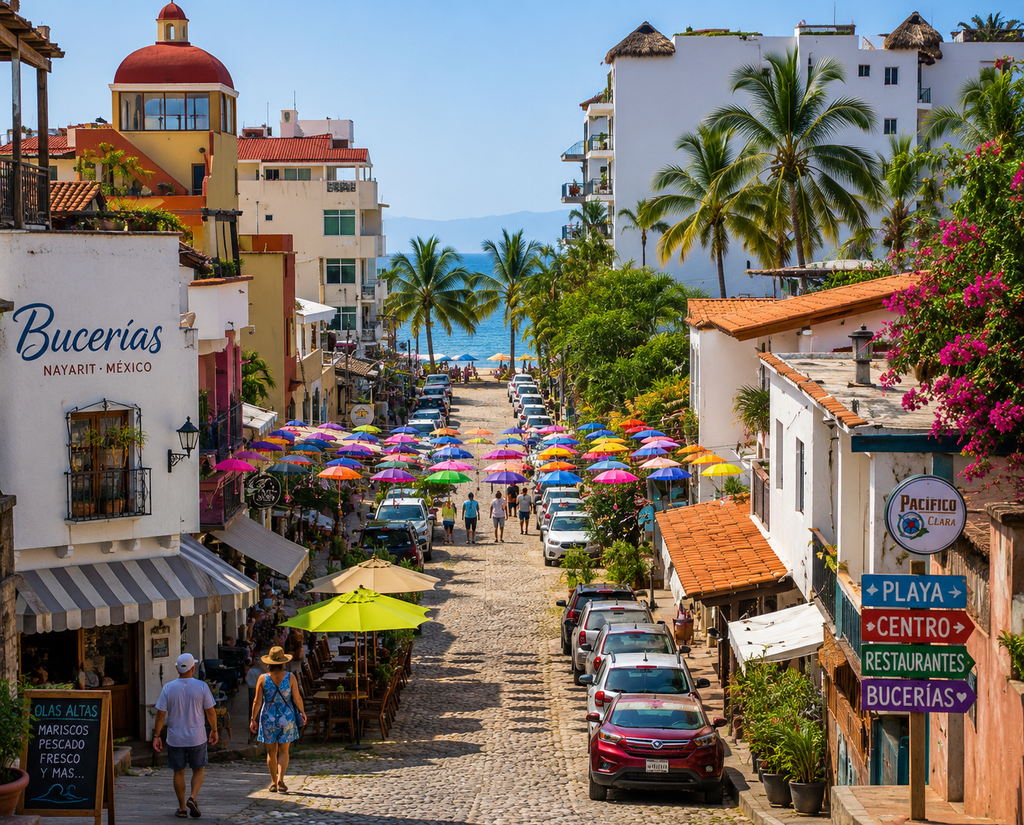
Bucerías is located on Banderas Bay in Nayarit, just north of Puerto Vallarta.
It has changed enormously, but it still feels like a Mexican town rather than a purpose-built resort.
That’s important.
You can live close to the beach and walk to restaurants, cafés and shops. Visit the local market, enjoy a modern restaurant one night and a tiny family-run taco place the next, or simply walk kilometres along the beach.
And you’re still within relatively easy reach of a major international airport, modern medical services, supermarkets, golf, marinas and Puerto Vallarta.
Most importantly for many Canadians, you’re not starting from scratch.
There is already a large Canadian presence in Bucerías and throughout this part of Riviera Nayarit.
Spend a January afternoon walking around Bucerías and you’ll understand what I mean pretty quickly.
Bucerías Real Estate Offers Very Different Choices
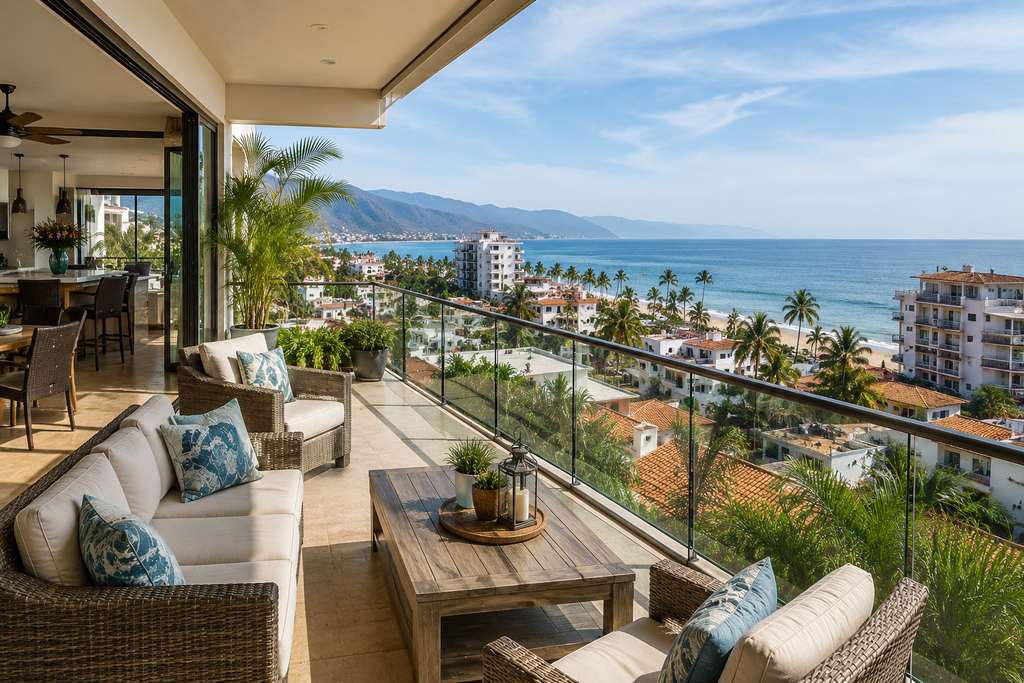
One mistake I see people make when they first start looking at Bucerías real estate is assuming Bucerías is one homogeneous market.
It isn’t.
The Bucerías Golden Zone appeals to buyers who place a premium on walkability, restaurants and easy beach access.
Other parts of Bucerías offer newer condominium developments, ocean views, rooftop pools and modern amenities.
Move farther away from the beach and both the neighbourhood character and the real estate options change.
And Bucerías isn’t the only choice.
Depending on the lifestyle you’re looking for, we may also look at Nuevo Nayarit, Flamingos, La Cruz de Huanacaxtle and other communities around Banderas Bay.
That’s why I usually tell buyers not to begin by falling in love with a property they found online.
Choose the community first. Then choose the property.
A beautiful condo in the wrong neighbourhood is still the wrong condo.
Buying Property in Mexico Is Different — But It Doesn’t Have to Be Complicated
One of the first questions Canadian buyers ask me is whether foreigners can actually own real estate near the Mexican coast.
Yes.
Because Bucerías is within Mexico’s restricted coastal zone, foreign residential buyers generally acquire beneficial rights to property through a fideicomiso, or Mexican bank trust.
The Mexican bank serves as trustee, while the foreign purchaser is the beneficiary of the trust.
The structure is unfamiliar to most Canadians, which can make it sound intimidating when they first hear about it.
Once it’s properly explained, it’s much easier to understand.
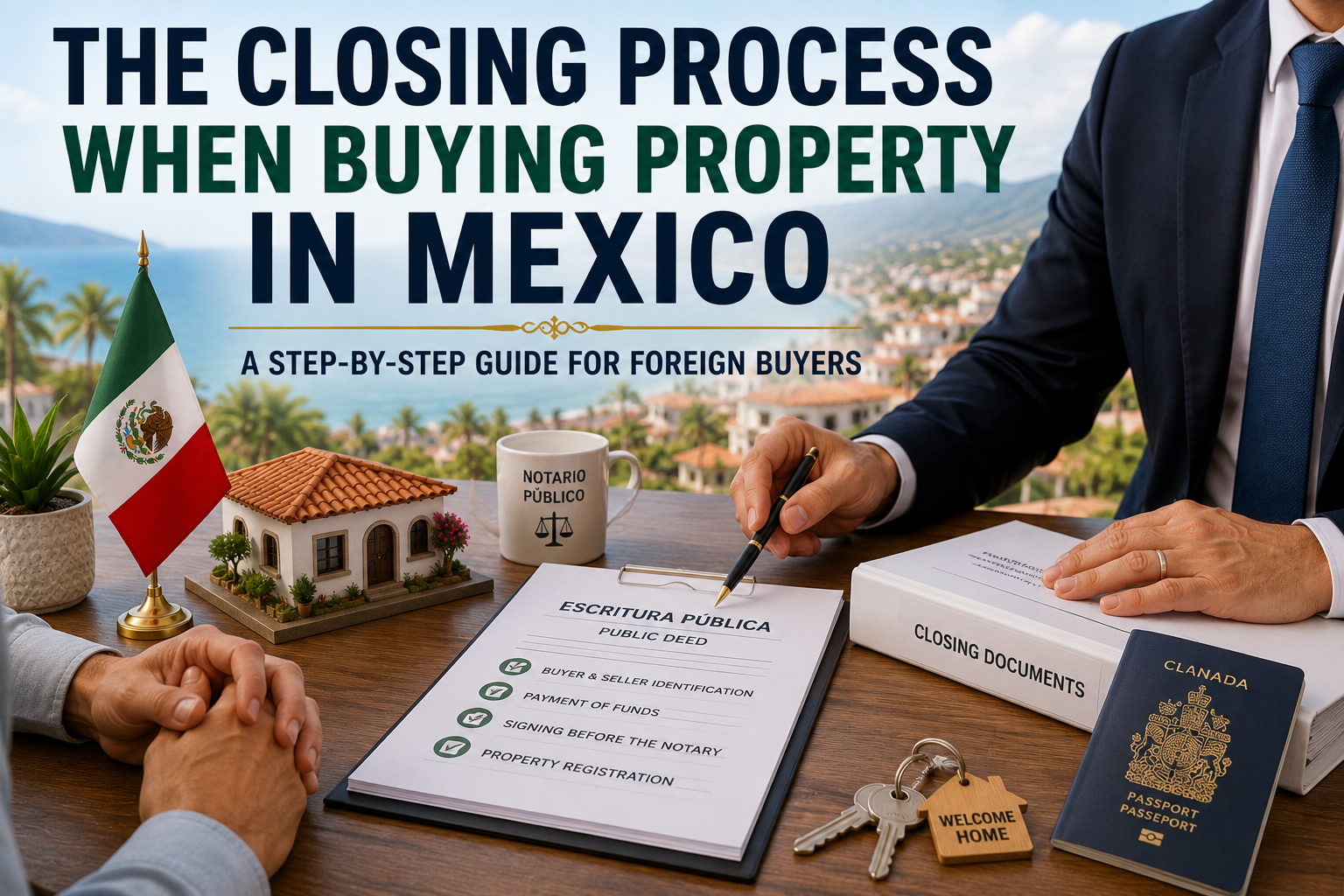
What matters is knowing how the purchase process works, understanding closing costs, carrying out proper due diligence, reviewing condominium documents where applicable, confirming title and understanding the roles of the professionals involved in the closing.
Mexico isn’t Canada.
Trying to pretend the systems are identical doesn’t help anybody.
The better approach is to understand the Mexican system before you commit your money.
This Is Where Having the Right Bucerías Real Estate Agent Matters
My background before moving to Mexico included real estate, finance and construction in Canada.
When I began working in real estate here, I quickly realized that one of the most valuable things I could provide wasn’t simply access to Bucerías homes and condos for sale.
It was context.
What does this document mean?
What happens after the offer is accepted?
Who is responsible for this?
How does the fideicomiso work?
What should we be looking for in the condominium documents?
How do the different areas of Bucerías compare?
What are the potential issues we need to investigate before moving forward?
Those are the questions that matter.
My business is focused on buyer representation. When I’m representing a buyer, my job is to look after that buyer’s interests throughout the purchase.
I would much rather have a client ask me twenty questions before buying than discover one unanswered question afterward.
Confidence comes from understanding what you’re doing.
Don’t Sell Arizona or Florida on Friday and Buy Bucerías on Monday
If you’re one of the Canadians selling U.S. property and thinking seriously about making a change, I’m going to give you advice that might sound strange coming from a real estate agent.
Don’t rush.
Come to Bucerías first.
Rent somewhere.
Stay long enough that you’re doing normal things instead of vacation things.
Go grocery shopping.
Walk around the Golden Zone.
Explore the beach.
Drive through Nuevo Nayarit.
Spend an afternoon in La Cruz.
See what Bucerías is like at 8:00 in the morning, not just at sunset with a margarita in front of you.
Look at some properties while you’re here, but don’t make the property the entire purpose of the trip.
You’re choosing where you’re going to spend a significant part of your life.
The lifestyle decision should come first.
Maybe the Bigger Question Isn’t About Trump
Governments change.
Donald Trump won’t be president forever.
Tariffs can eventually be removed.
Immigration policies can change.
Canada and the United States could repair much of the damage to their relationship.
I sincerely hope they do.
But for Canadians selling U.S. property, there’s another possibility worth considering.
Maybe the events of the last couple of years have simply caused Canadians to question an assumption we’ve made for decades:
Why does spending the winter somewhere warm automatically mean spending it in the United States?
It doesn’t.
There are other choices.
And judging by the travel numbers, Canadians are discovering them.
From a U.S. Vacation Property to a Winter Home in Bucerías
If you own a vacation property in Arizona, Florida, California or somewhere else in the United States and you’re perfectly happy there, I’m not trying to convince you to leave.
But if you’ve already started thinking about selling, the world looks quite different today than it did when I wrote my original article in April 2025.
Back then, the idea of Canadians selling U.S. property in significant numbers was largely speculation.
Today we know that Canadian travel to the United States has fallen dramatically.
We know Canadians have shifted some spending away from American products and services. Canadian searches for U.S. real estate have also declined. And a national survey found that more than half of Canadian U.S. property owners surveyed were planning to sell within a year, with the majority pointing to the American political administration as their main reason.
And I now have prospective buyers telling me personally that they’re selling their Arizona property and looking toward Mexico because of what’s happening between Canada and the United States.
That’s quite a change in less than eighteen months.
So if you’re among the Canadians selling U.S. property, the question isn’t whether you should immediately buy somewhere else.
Maybe it’s simply:
If you were choosing your winter home from scratch today, knowing everything you know now, would you make the same choice?
If the answer is no, come down and have a look at Bucerías.
Walk the beach.
Explore the neighbourhoods.
Look at some Bucerías real estate and see what your budget can buy.
Ask questions about owning property in Mexico.
Learn how the buying and closing process works.
Compare Bucerías with Nuevo Nayarit, Flamingos and La Cruz.
And then decide for yourself.
I’ve already made the move from Canada to Bucerías. Today, I help other Canadians and Americans figure out whether buying property here makes sense for them.
If you’d like to explore Bucerías homes or condos for sale, or you simply want to understand what would be involved in moving your winter lifestyle from the United States to Mexico, contact Jim McKinnon at Dream Big In Mexico Real Estate.
I’m happy to show you around and answer the questions I would have wanted answered when I first started learning how real estate works in Mexico.
No pressure. No need to decide anything on the first trip.
Come see Bucerías first.
After all, if even Lake Ontario can apparently become “Lake America,” perhaps it’s not unreasonable to reconsider where you want to spend your winters.