By Jim McKinnon, Dream Big In Mexico Real Estate — Bucerías, Nayarit
If you’re a Canadian or American buying property in Mexico’s coastal areas, understanding a fideicomiso in Mexico is one of the first things you need to do. If you’re Canadian or American and have started looking at Bucerías real estate, Puerto Vallarta, Nuevo Nayarit, La Cruz de Huanacaxtle or elsewhere around the Bay of Banderas, there’s a word you’re going to hear fairly quickly.
It can also be one of the first things about buying property in Mexico that makes a foreign buyer nervous.
I understand why — and I can say that from personal experience.
Most Canadians and Americans are familiar with a real estate system where you purchase a property, your name goes on title, and that’s basically the end of the discussion about ownership.
Mexico works differently in certain parts of the country.
When foreign buyers start hearing terms like “bank trust,” “restricted zone” and “the bank holds title,” it’s natural to wonder:
If the bank is on the title, do I actually own my property?
The short answer is that a properly established fideicomiso gives a foreign beneficiary extensive rights to use, enjoy, control, improve, lease, sell and pass on the property, subject to Mexican law and the terms of the trust.
It isn’t a lease from the bank.
The bank doesn’t get to live in your condo.
It doesn’t decide when you sell.
And it doesn’t suddenly become entitled to your property simply because it acts as trustee.
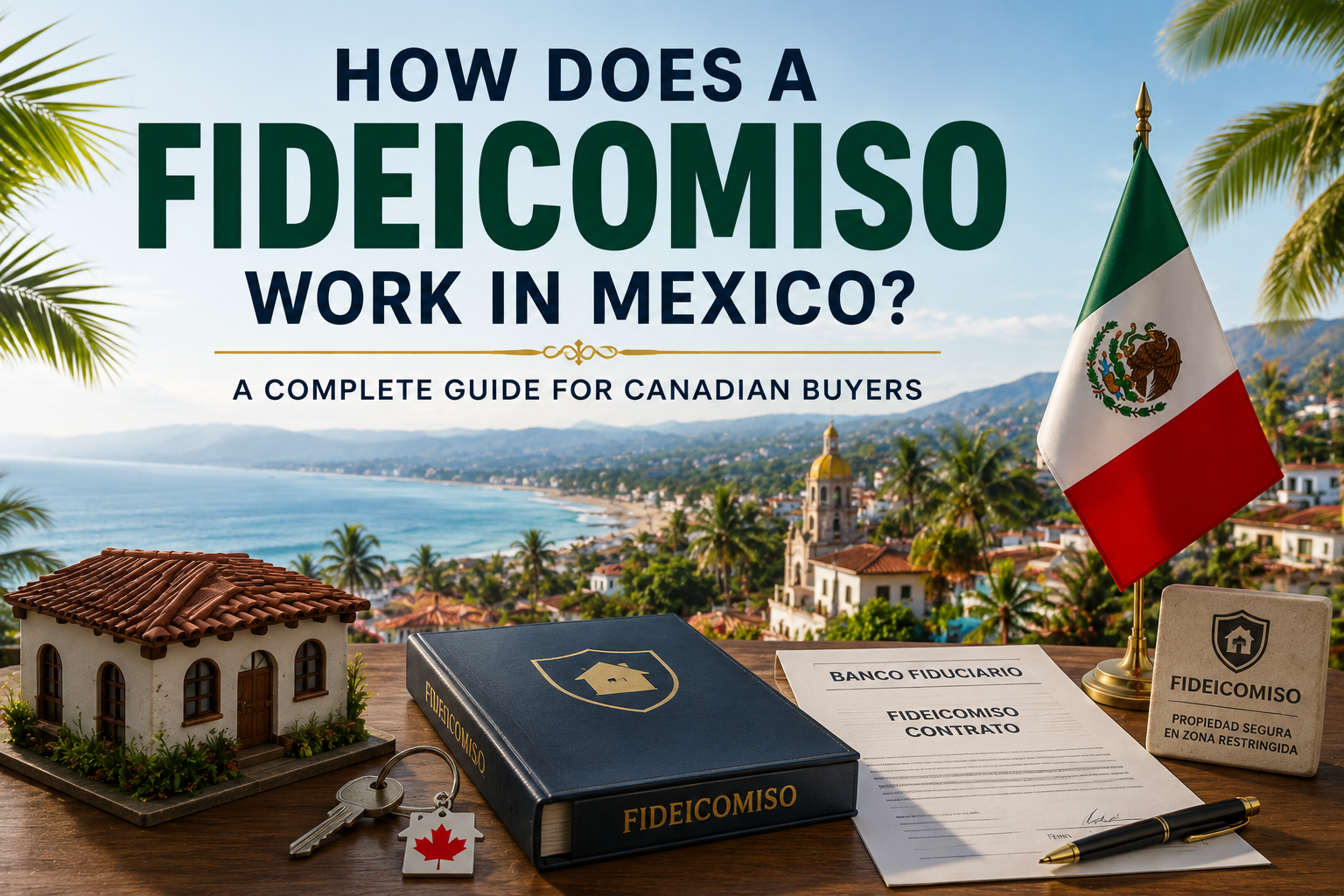
The fideicomiso is the legal structure Mexico uses to allow foreigners to acquire beneficial rights in residential real estate within what’s known as the restricted zone.
If you’re considering buying real estate in Bucerías or elsewhere around the Bay of Banderas, understanding how this structure works is important.
The good news is that it isn’t nearly as intimidating once someone explains it in normal English.
That’s what I’m going to try to do here.
Why Does Mexico Require a Fideicomiso in the Restricted Zone?
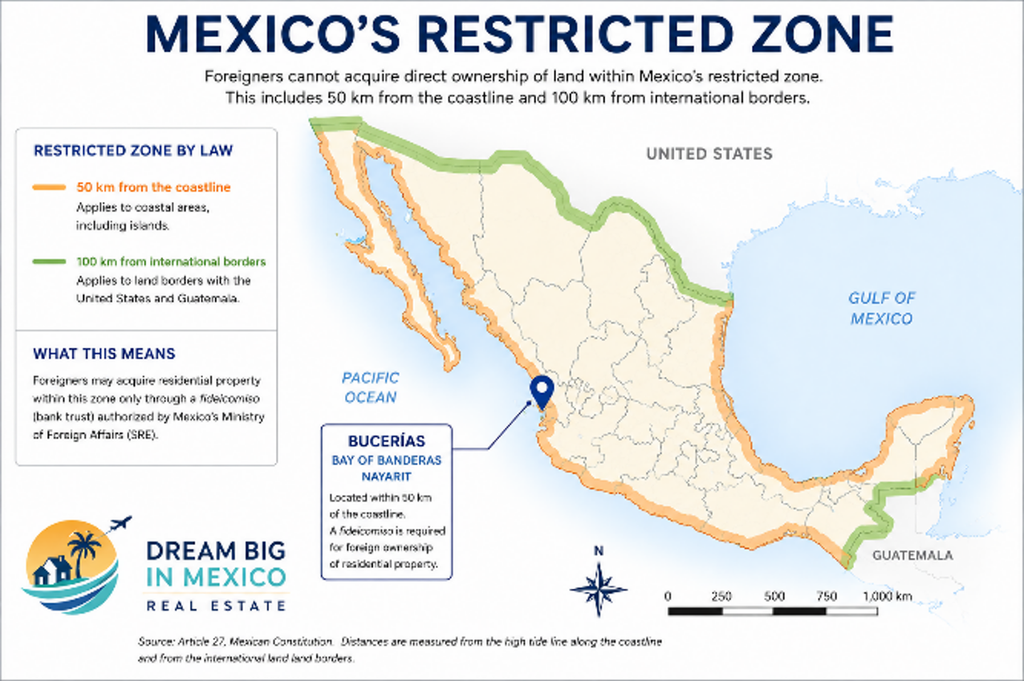
The concept originates in Article 27 of the Mexican Constitution.
Foreigners cannot acquire direct ownership of land within what Mexico defines as its restricted zone: generally 100 kilometres from an international border and 50 kilometres from the coastline.
That obviously includes a large portion of the real estate Canadians and Americans are interested in purchasing.
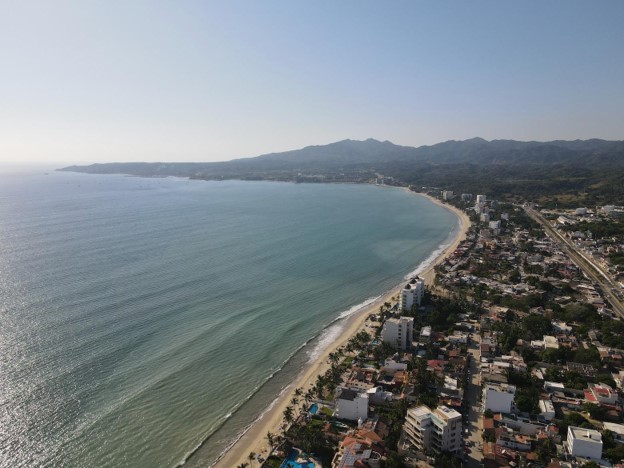
Bucerías is on the Pacific coast.
So are Puerto Vallarta, Nuevo Nayarit, La Cruz, Punta de Mita, Sayulita, San Pancho and many of the other communities people consider when they’re looking for a home or condo in this part of Mexico.
That doesn’t mean foreigners can’t buy residential property here.
They certainly can.
Instead, Mexican law provides a mechanism through which a qualified Mexican bank acts as trustee and holds title to the property for the benefit of the foreign purchaser.
That mechanism is the fideicomiso.
For residential property within the restricted zone, the fideicomiso is therefore not some unusual workaround dreamed up by real estate agents. It is an established legal mechanism used for foreign ownership interests in property within the restricted zone.
The Secretaría de Relaciones Exteriores — Mexico’s Ministry of Foreign Affairs, commonly referred to as the SRE — is involved in authorizing these trusts.
For most foreign buyers purchasing a Bucerías condo or home, the fideicomiso simply becomes part of the normal closing process.
What Exactly Is a Fideicomiso in Mexico?
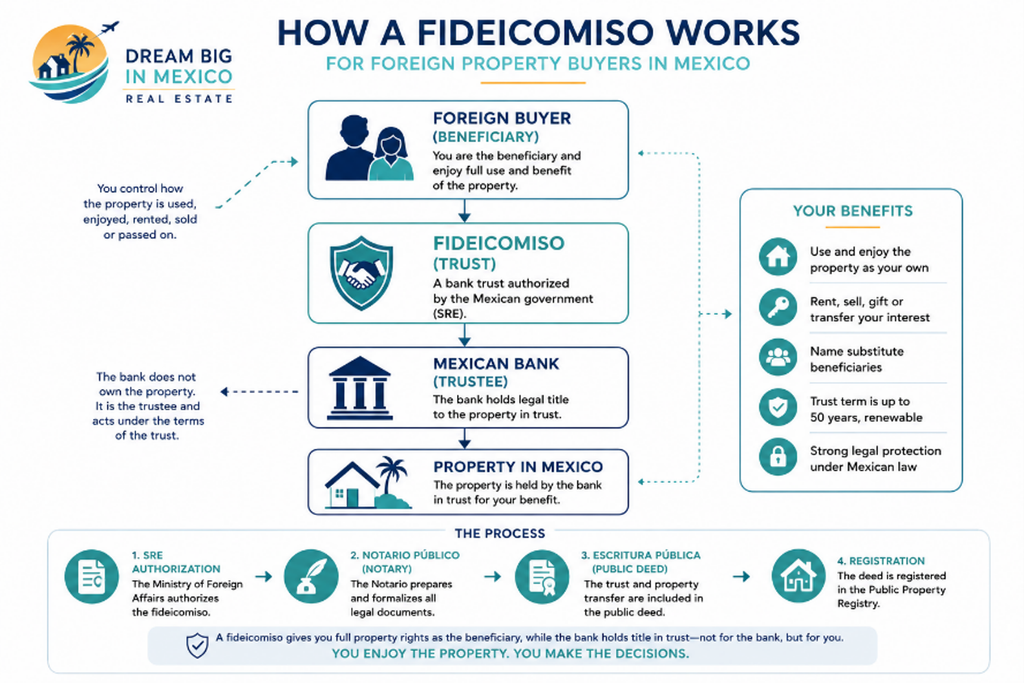
The easiest way to understand a fideicomiso is to think of it as a three-party arrangement.
There is:
- The seller or person transferring the property into the trust.
- A Mexican banking institution acting as the fiduciario, or trustee.
- You, the foreign buyer, acting as the fideicomisario, or beneficiary.
The bank holds legal title in its capacity as trustee.
You hold the beneficial rights under the trust.
That’s the part that sometimes gets lost when someone simply tells a prospective Canadian buyer:
“The bank owns your house.”
That statement creates a misleading impression.
The bank isn’t buying the property for itself.
It isn’t making the investment.
It isn’t deciding how you’re going to decorate your condo in Bucerías or whether you can spend January there.
It is acting in a fiduciary capacity under the trust.
As beneficiary, you have the rights established through the fideicomiso and applicable Mexican law.
For a typical residential property, those rights allow you to use and enjoy the property and, subject to the applicable legal requirements, sell it, transfer your beneficial interest, improve it, rent it and designate substitute beneficiaries.
That’s much closer to the practical reality of what foreign buyers experience.
I Understood Trusts — and I Still Had Questions When We Bought Our Home
Before entering the real estate industry professionally in Mexico, I made the decision to become a member of AMPI — the Mexican Association of Real Estate Professionals. Although joining AMPI wasn’t mandatory for me to begin working in the industry, I felt strongly that if I was going to advise people making one of the largest purchases of their lives in a country with a very different legal system, I needed to properly understand that system myself.
That involved 96 hours of training covering the Mexican real estate industry, including fairly in-depth coverage of Mexican legislation and the formation and function of the fideicomiso.
I also came into Mexican real estate with a background as a Certified Financial Planner in Canada. Because trusts and trust structures are commonly used in financial and estate planning, the basic concepts behind separating legal title, beneficial interests and fiduciary responsibilities weren’t foreign to me.
That combination made it easier for me to understand why the fideicomiso is structured the way it is and the protections and benefits a properly established trust can provide.
But here’s the interesting part.
Even after all that training and my previous professional experience, when my wife and I bought our own house in Bucerías, I still had some anxiety about making sure everything was correct.
It’s one thing to understand something academically.
It’s another thing when it’s your money, your house and your name on the documents.
That experience has stayed with me when working with buyers. When someone tells me they’re nervous about a fideicomiso, I don’t dismiss that concern.
I understand it.
The solution isn’t telling someone, “Don’t worry, everybody does it.”
The solution is helping them understand how it works and making sure the appropriate professionals are involved so they can become comfortable with the transaction.
Does the Bank Control My Property in a Fideicomiso?
This is probably the biggest misconception I hear about fideicomisos.
The answer, in practical terms, is no — not in the sense most buyers fear when they hear the word “trust.”
The bank is the trustee.
Its role is governed by the trust agreement and Mexican law.
It doesn’t get to treat your property as though it were one of the bank’s normal assets.
The beneficiary is the person who receives the rights of use and enjoyment established by the trust.
That distinction matters.
Imagine buying a condo in the Bucerías Golden Zone.
You furnish it.
You live there for five months every winter.
Your family visits.
Perhaps you eventually decide to rent it while you’re away.
Years later, you decide you’d rather have a home in Bucerías with a yard and pool, so you sell the condo.
The bank isn’t making those lifestyle decisions for you.
It’s there because Mexican law requires this trust structure for foreign beneficiaries acquiring these property rights within the restricted zone.
That is very different from the idea that you’ve handed your money to a bank and are hoping they’ll let you use “their” condo.
What Happens if the Bank Has Financial Problems?
This is another question I hear from buyers, and it’s a reasonable one.
If your Canadian bank owned your Mexican condo and the bank failed, you’d understandably be concerned.
But that isn’t how the fideicomiso is structured.
Property held by the bank in its fiduciary capacity is not simply treated as an ordinary asset belonging beneficially to the bank.
The bank’s role is trustee.
That separation is an important feature of the arrangement.
If a trustee bank were ever replaced or another institution needed to take over the fiduciary responsibilities, there are legal mechanisms for doing so.
The underlying beneficial interest doesn’t simply disappear because the identity or circumstances of the trustee change.
This is one of those areas where I encourage buyers to ask questions during the closing process.
You should understand which bank is acting as trustee, what the annual trustee fee is, when that fee is due, who your substitute beneficiaries are, how the fideicomiso is described in your deed, when the trust expires and what would be involved in extending it.
Don’t be afraid to ask these questions.
When you’re buying property in Mexico, understanding what you’re signing is far more important than pretending you understand everything because you’re worried about asking a “stupid” question.
There are no stupid questions when you’re spending several million pesos on a home.
How Long Does a Fideicomiso Last?
A fideicomiso used for foreign ownership of residential property in Mexico’s restricted zone can be authorized for a period of up to 50 years.
That sometimes creates another moment of panic.
Buyers hear “50 years” and think:
Wait a minute. Does Mexico take my property away after 50 years?
No.
The 50-year period is the authorized term of the fideicomiso, not a countdown after which the government automatically confiscates your condo.
Mexican law provides a process through which the duration can be extended.
If you’re buying an existing property, there’s another important point to understand:
You may be dealing with an existing fideicomiso that already has time remaining on it.
Depending on the transaction and advice of the closing professionals, the existing trust rights may be assigned or the transaction may involve establishing a new fideicomiso.
This is one of the reasons I don’t like reducing Mexican real estate transactions to generic statements such as:
“This is how every closing works.”
Every property has its own history.
Every deed needs to be reviewed.
Every existing fideicomiso needs to be examined.
Every transaction has its own circumstances.
The process is familiar.
The individual transaction still deserves careful attention.
Can I Sell a Property Held in a Fideicomiso?
Yes.
A fideicomiso doesn’t lock you into the property.
Foreign owners routinely sell homes and condos held through fideicomisos.
If you eventually sell your Bucerías property, the transaction can be structured to transfer the beneficial rights to another eligible foreign purchaser, establish a new trust where appropriate, or transfer the property according to the legal structure required for the buyer.
The exact mechanism will depend on the circumstances of the transaction.
From your perspective as a seller, though, the important concept is simple:
You can sell.
The fideicomiso doesn’t mean the bank decides whether you’re allowed to move.
Can I Leave Property in a Fideicomiso to My Children?
This is actually one of the features of the fideicomiso that I think buyers should pay more attention to.
The trust can provide for substitute beneficiaries.
I’ve had several clients who were very pleased when they learned about this feature.
A fideicomiso can allow the primary beneficiary to designate one or more substitute beneficiaries who can assume the beneficial interest following the primary beneficiary’s death, once the required documentation and legal processes have been completed.
For someone purchasing a significant asset in Mexico, that’s worth understanding.
The concept also isn’t particularly unusual when you look at it through the lens of financial and estate planning. Wealthy families have used trusts for generations partly because a properly structured trust can provide an orderly mechanism for dealing with assets following death.
A Mexican fideicomiso isn’t the same thing as every trust you might encounter in Canada or the United States, and I wouldn’t suggest treating it as a substitute for proper estate planning. Mexican and home-country legal and tax implications should be discussed with qualified professionals.
But the ability to designate substitute beneficiaries can be a very valuable feature.
For many Canadian and American buyers, understanding that their interest in their Mexican home doesn’t simply disappear when they die provides considerable peace of mind.
When establishing your fideicomiso, pay attention to exactly who is listed.
Names need to be correct.
If circumstances change — divorce, remarriage, death of a beneficiary or a change in your estate plans, for example — don’t assume everything automatically updates itself.
Speak with the appropriate Mexican legal and fiduciary professionals about what changes may be required.
Is a Fideicomiso the Same as a Mexican Corporation?
No.
These are two different legal structures.
You’ll occasionally hear someone say:
“Don’t bother with a fideicomiso. Just set up a Mexican corporation.”
Be careful with overly simplistic advice.
Mexican corporations can own property, including in circumstances where different rules apply depending upon the property and its use. Mexican law, for example, provides specific treatment for Mexican companies with foreign participation acquiring restricted-zone property for non-residential purposes.
That doesn’t mean a corporation is automatically the appropriate structure for someone buying a condo to spend winters in Bucerías.
The correct ownership structure depends on the intended use of the property and the buyer’s legal, tax and personal circumstances.
If you’re purchasing a residence, get proper professional advice before deciding that a corporation is somehow “better” because somebody at a restaurant told you that’s what they did.
This brings me to a general rule I’ve developed about buying real estate in Mexico:
The more confidently someone at happy hour tells you there’s one simple trick that everyone should use, the more questions you should probably ask.
Mexico isn’t Canada with palm trees.
It has its own legal system, tax system, terminology and real estate practices.
That’s not a reason to be afraid of buying here.
It’s a reason to work with people who understand the process.
How Is a Fideicomiso Created When I Buy Property?
Let’s assume you’re a Canadian couple looking at condos for sale in Bucerías.
You find a property you love.
An offer is prepared and negotiated.
The offer is accepted.
Now the transaction moves toward closing.
The exact process can vary, but the fideicomiso becomes one component of the legal closing process.
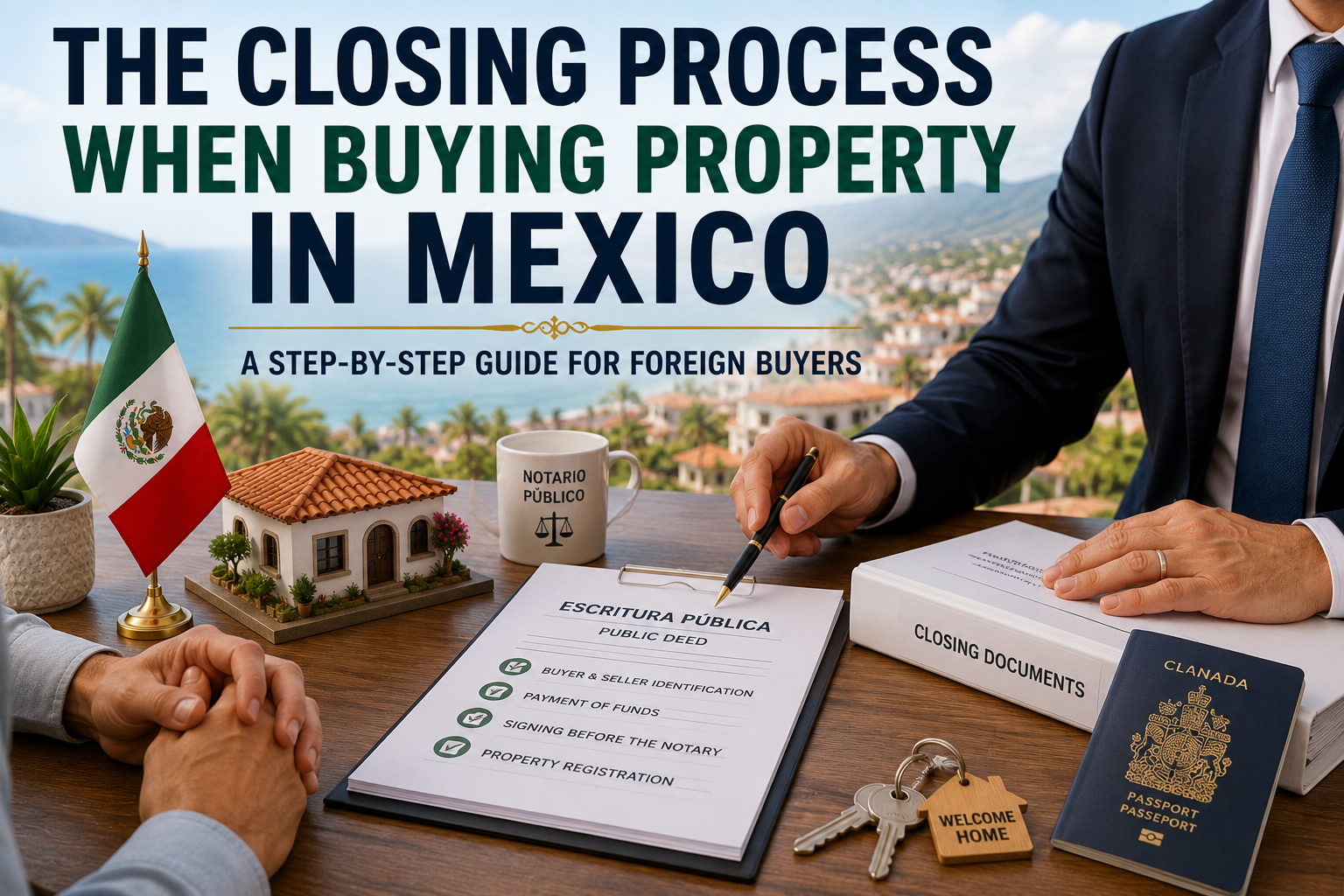
The transaction typically involves a Mexican Notario Público, the trustee bank, the SRE process and the professionals coordinating the transaction.
This is another area where the Mexican system differs significantly from what Canadians may expect.
A Mexican Notario Público is not simply the Mexican equivalent of the person who notarized your travel consent form back home.
Mexican notarios are highly qualified legal professionals appointed under state authority who play an important role in real estate transfers.
Among other responsibilities applicable to a transaction, the notario verifies and formalizes the legal transfer, reviews relevant documentation, calculates or oversees applicable taxes and ensures the transaction is properly recorded.
Where a fideicomiso is required, the necessary trust documentation and government authorization become part of that overall closing process.
The fideicomiso must ultimately be contained in a public deed — escritura pública.
That’s an important document.
Keep it.
What Does a Fideicomiso Cost — and What Should I Budget for Closing Costs?
This is one of the conversations I like to have before we start looking at properties, rather than after someone falls in love with one.
One of the first things I do when working with a buyer is establish their purchasing budget.
But when someone tells me their budget is $400,000 USD, for example, I need to understand what that actually means.
Is $400,000 their target purchase price?
Or is $400,000 the total amount of capital they have available for both the property and the costs of completing the transaction?
Those are two different budgets.
As a general rule of thumb in our area, I initially tell buyers to budget approximately 4% to 7% above the purchase price for closing costs and to err on the side of caution.
That is a budgeting guideline, not a quote.
The actual percentage can fall outside that range.
That’s particularly important with lower-priced properties because many transaction costs are fixed government, administrative, professional or fiduciary charges rather than costs calculated strictly as a percentage of the purchase price. As a result, those fixed costs represent a larger percentage on a lower-priced property.
Closing costs can include items such as acquisition taxes, notario and registration expenses, certificates, appraisals and costs associated with establishing or transferring the fideicomiso.
The trustee bank can also have its own establishment and ongoing administration fees.
Once one of our buyers has an accepted offer, we request a formal Closing Cost Estimate from the Closing Coordinator.
That’s when we stop relying on a rule of thumb and start looking at the estimated costs associated with that specific transaction.
It’s an important step because I want the buyer to know how much liquidity they’re likely to need well before closing.
I’d much rather have someone budget conservatively and discover they need less money than expected than have them find the perfect property and suddenly discover they haven’t allowed enough cash for closing.
Who Actually Protects the Buyer in a Mexican Real Estate Transaction?
This is where choosing the right people matters.
I occasionally hear buyers say:
“The bank is involved, so I assume the bank checks everything.”
Don’t make that assumption.
The trustee bank has a specific fiduciary role.
The notario has specific legal responsibilities.
Your closing coordinator or attorney has specific responsibilities.
And your real estate agent has a different role.
A good buyer’s agent should be helping you understand the process, identify questions, coordinate with the appropriate professionals and make sure issues aren’t simply disappearing into an email chain nobody is following.
I am not your lawyer.
I don’t pretend to be.
When a question requires a legal opinion, I want a qualified Mexican legal professional answering it.
But there’s a big difference between an agent saying:
“Don’t worry about it. This is Mexico.”
and an agent saying:
“I don’t want to guess at that. Let’s get the answer from the person responsible for that part of the transaction.”
I strongly prefer the second approach.
Buying property in Bucerías should be exciting. It should not require blind faith.
What Should Be Checked Before You Buy?
The fideicomiso is important, but it’s only one piece of due diligence.
Before completing a real estate purchase in Bucerías or elsewhere in Riviera Nayarit, the transaction may require review of matters such as:
- The seller’s escritura
- The existing fideicomiso, if applicable
- Property identification and legal description
- Property-tax status
- HOA or condominium obligations
- Existing liens or encumbrances
- Seller authority
- Building and condominium documentation
- Applicable permits or documentation
- The status of utilities and other obligations
- The physical condition of the property
- The proposed ownership and fideicomiso structure
- Substitute beneficiary information
- Closing costs and taxes
Not every property will present the same issues.
A relatively new condominium in Nuevo Nayarit may involve a very different due-diligence process from an older house in Bucerías.
A pre-construction purchase has its own set of considerations.
Land can present different issues again.
The important point is that a beautiful ocean view doesn’t replace due diligence.
I’ve seen buyers become emotionally attached to a property remarkably quickly.
I understand it.
You walk onto a rooftop terrace, see the Bay of Banderas in front of you and start imagining friends visiting next winter.
That’s part of the fun.
My job is also to keep paying attention to the boring stuff.
Should I Be Afraid of Buying Property in Mexico?
I don’t think fear is useful.
Neither is being careless.
Thousands of foreigners own property in Mexico, and fideicomisos are an established part of property ownership for foreign beneficiaries in coastal areas.
What I encourage buyers to do is replace uncertainty with information.
Instead of asking:
“Is buying property in Mexico safe?”
ask better questions:
Who currently holds title?
Is there an existing fideicomiso?
Who is the trustee?
How much time remains on it?
Are there liens or outstanding obligations?
Who is the notario?
Who is coordinating the closing?
What are my estimated closing costs?
Who are my substitute beneficiaries?
What exactly am I signing?
Those are questions we can work with.
Buying Property in Bucerías as a Canadian: Sometimes the Differences Are Unexpected
A significant number of people looking at Bucerías real estate come from Canada.
I understand that buyer particularly well because I’m Canadian too.
One of the biggest adjustments is accepting that the process isn’t going to look exactly like a transaction in Alberta, British Columbia, Saskatchewan or Ontario.
That’s okay.
Different doesn’t automatically mean dangerous.
But different does mean you shouldn’t make assumptions based on how things work back home.
And sometimes the differences aren’t where you’d expect them.
One of the things that genuinely surprised me when I started working in Mexican real estate wasn’t related to fideicomisos, notarios or contracts.
It was showing houses.
In Canada, I was accustomed to a buyer’s agent scheduling an appointment with the listing agent and then accessing the property through an electronic lockbox. The buyer’s agent and clients would enter the property together, and the buyer’s agent would show them through the home.
In our market in Mexico, the listing agent — or their representative — is normally present for the showing and typically leads the prospective buyers and their buyer’s agent through the property.
That takes some getting used to.
Some buyers find it uncomfortable, particularly if the listing agent starts asking questions such as where they’re from, exactly what they’re looking for or what their budget is.
Those are conversations I would prefer my clients to have with me, not the person representing the seller.
I even once had a listing agent hand their business card directly to one of my clients during a showing — something I certainly didn’t consider appropriate.
There is, however, an advantage to having the listing representative there.
It gives both the buyer and buyer’s agent an opportunity to ask detailed questions directly of the person who should be among the most familiar with the property.
The important part is understanding who represents whom.
The listing agent’s responsibility is to their seller.
As a buyer’s agent, my responsibility is to my buyer.
That distinction matters whether we’re discussing the asking price, negotiating an offer, evaluating information provided during a showing or working through the closing process.
Mexico isn’t better or worse because the procedures are different.
You simply need to understand the rules of the road.
What Happens When I Eventually Sell?
Someday you may sell.
Perhaps Bucerías was originally going to be your winter escape and eventually became your full-time home.
Maybe you want something larger.
Maybe you’re downsizing.
Maybe you want to move from a condo near the beach to a house farther inland.
Whatever the reason, your fideicomiso becomes part of the sale process.
The notario and closing professionals will review the existing trust and determine the appropriate procedure for the transaction.
Depending upon the circumstances, that can involve assigning beneficial rights, terminating an existing fideicomiso and creating another, or another legally appropriate structure.
There may also be tax implications when you sell Mexican real estate.
Do not wait until you’ve accepted an offer to start thinking about those.
If you’re selling property in Bucerías, one of the early questions should be:
What documentation do we have, and what will the notario need?
Gathering documentation early can save an enormous amount of frustration later.
Can a Fideicomiso Be Cancelled?
Yes.
A fideicomiso can be extinguished when appropriate — for example, in connection with a transfer where the existing trust will no longer be required.
The trustee bank has regulatory responsibilities relating to that process.
This is another reason the trust should not be thought of as some informal agreement with a bank manager.
It exists within a regulated legal framework.
The documentation matters at the beginning.
It matters during ownership. And it matters when the property is eventually transferred.
Five Fideicomiso Mistakes I Would Try to Avoid
After working with buyers in the Bucerías and Bahía de Banderas real estate market, there are a few habits I strongly encourage people to avoid.
1. Taking Legal Advice From Facebook Groups
Facebook groups can be fantastic for finding out where to get tacos or which beach is nicest on a Tuesday morning.
They’re less reliable for interpreting Mexican property law.
You’ll see confident answers from people whose transaction happened 12 years ago in another state under completely different circumstances.
Use social media to generate questions.
Use qualified professionals to answer them.
2. Assuming Mexico Works Like Canada or the United States
It doesn’t.
That doesn’t make the Mexican system inferior.
It makes it different.
Understanding those differences before making an offer is much easier than discovering them three days before closing.
3. Ignoring the Existing Fideicomiso
If the seller is a foreigner, there may already be a fideicomiso associated with the property.
That document matters.
Get it into the hands of the appropriate closing professionals.
4. Forgetting About Substitute Beneficiaries
You’re buying an asset.
Think beyond possession day.
Make sure you understand how substitute beneficiaries are designated and confirm that the information is correct.
5. Choosing an Agent Based Only on Who Opens the Door
Finding properties is the easy part.
You can look at listings online from your sofa in Calgary, Vancouver, Toronto or Minneapolis.
The more valuable work often starts after you find the property you want to buy.
That’s when we start dealing with how offers work in Mexico, negotiations, documentation, property inspections, legal questions, closing coordination, fideicomiso issues, notarios, timelines and all the little things that don’t fit nicely into an MLS listing.
That’s why I believe foreign buyers should think about choosing a real estate agent in Mexico differently than they might think about choosing someone simply to show them houses.
What I Tell Buyers Who Are Nervous About the Fideicomiso
Usually something pretty simple:
Don’t sign something you don’t understand.
But also don’t reject a good property simply because Mexico uses a legal structure you haven’t encountered before.
Ask questions.
Get explanations.
Have the appropriate professionals review the documents.
Understand the role of the trustee bank.
Understand the role of the notario.
Understand your rights as beneficiary.
Understand the costs.
Understand your substitute-beneficiary provisions.
And then make an informed decision.
That’s a much better approach than either extreme:
“Mexico is scary. I’m not buying anything.”
or:
“Don’t worry about anything. Everybody does it.”
Neither is particularly useful.
Information is.
Find the Right Community Before You Find the Right Property
There’s another lesson I’ve learned that doesn’t directly involve fideicomisos, but I think is just as important to buying successfully in this area.
Figure out which community fits you before becoming obsessed with individual listings.
I’ve worked with clients who initially thought they wanted an oceanfront property in La Cruz de Huanacaxtle.
On paper, it made sense.
Then they spent time in the community, we looked at properties together, and they started figuring out what actually mattered to them.
They ultimately purchased a house in a gated community in Bucerías approximately two kilometres from the beach.
Why?
Moving away from the oceanfront gave them a substantially larger lot and considerably more privacy. More importantly, after experiencing the different communities, they realized Bucerías was simply a better fit for their tastes, lifestyle and long-term goals.
Neither choice was right or wrong.
It was about finding what was right for them.
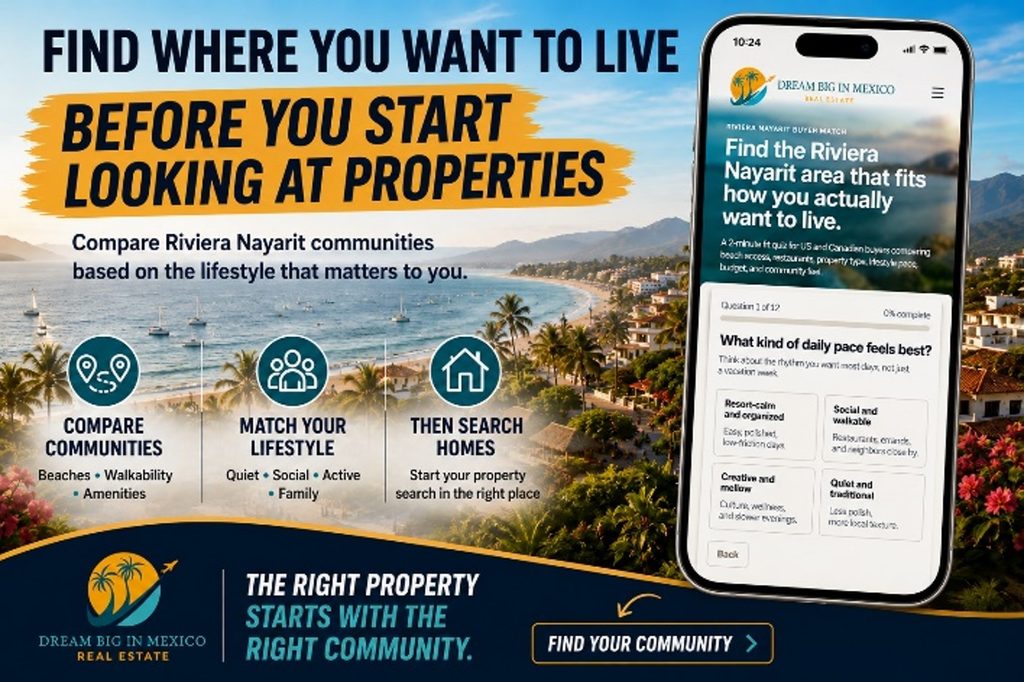
Experiences like this are one of the reasons we created our Neighborhood Selector.
It asks a series of questions about your lifestyle and preferences and helps identify which communities around the Bay of Banderas are likely to fit you best.
Do you value walkability?
Nightlife?
Quiet?
Beach access?
A larger home?
Privacy?
Restaurants?
A traditional Mexican town?
A gated community?
Your answers can point you toward very different locations.
I’d rather help someone figure that out first and then start looking at listings.
Because finding an amazing house in the wrong community doesn’t make it the right house.
Why Local Experience Matters When Buying Bucerías Real Estate
You can learn an enormous amount about Mexican real estate online.
In fact, I hope this article has helped.
But there is a point where general information ends and a specific property begins.
That’s where things get interesting.
The condo you’re considering has its own escritura.
Its own ownership history.
Its own HOA.
Its own physical condition.
Potentially its own fideicomiso.
Its own seller.
Its own closing circumstances.
And its own collection of questions.
That is where local experience becomes important.
Bucerías is also not exactly the same market as Puerto Vallarta.
Nuevo Nayarit isn’t the same as La Cruz.
And the right community for one buyer may be completely wrong for another.
Some people want to walk out the door and be surrounded by restaurants, cafés and activity.
Some want quiet.
Some want beachfront.
Others realize they’d rather be five or ten minutes from the beach and have a larger home with a private pool.
Some want rental potential.
Others never want a stranger sleeping in their bed.
The legal structure is only one part of buying successfully in Mexico.
The bigger goal is making sure you’re buying the right property, in the right community, through the right process.
Frequently Asked Questions About Fideicomisos in Mexico
Can Canadians own property in Bucerías, Mexico?
Yes. Foreign buyers can acquire beneficial rights in residential real estate in Bucerías through a fideicomiso because Bucerías is within Mexico’s coastal restricted zone.
Is a fideicomiso safe?
A fideicomiso is a legally recognized trust structure authorized under Mexican law. As with any significant real estate transaction, the individual property, documentation, trust terms and transaction should be reviewed by the appropriate qualified professionals.
Does the bank own my Mexican house?
The bank holds title in its capacity as trustee. The foreign purchaser is the beneficiary and receives the use and enjoyment rights established under the fideicomiso. Saying simply that “the bank owns your house” leaves out the most important part of how the legal relationship works.
How long does a fideicomiso last?
The authorization may be granted for up to 50 years and can be extended through the applicable legal process.
Can I sell a house or condo that’s in a fideicomiso?
Yes. Property interests held through a fideicomiso can be transferred as part of a sale, subject to the appropriate Mexican legal and closing procedures.
Can my children inherit my property in Mexico?
A fideicomiso can identify substitute beneficiaries who may receive the beneficial interest following the beneficiary’s death, subject to the trust terms and applicable procedures. This should be considered as part of your broader estate planning.
How much should I budget for closing costs when buying in Bucerías?
As a preliminary planning guideline, I generally suggest that buyers budget approximately 4% to 7% above the purchase price and err on the side of caution. This isn’t a quote and actual costs can fall outside that range, particularly on lower-priced properties because many closing expenses are fixed rather than percentage-based. Once we have an accepted offer, we request a transaction-specific Closing Cost Estimate.
For a more detailed explanation, see our guide to closing costs when buying property in Mexico.
Do I need a fideicomiso everywhere in Mexico?
No. The fideicomiso requirement discussed here relates to foreign ownership interests within Mexico’s constitutionally defined restricted zone — generally 50 kilometres from the coastline and 100 kilometres from an international border.
Is Puerto Vallarta in the restricted zone?
Yes. Puerto Vallarta is a coastal community and therefore falls within the restricted zone.
Is Bucerías in the restricted zone?
Yes. Bucerías is located on the Bay of Banderas coastline in Nayarit and falls within Mexico’s restricted zone.
Is Nuevo Nayarit in the restricted zone?
Yes. Like Bucerías and Puerto Vallarta, Nuevo Nayarit is a coastal community and is within the restricted zone.
Do I need a Mexican lawyer to buy property?
The Mexican Notario Público plays a mandatory and important legal role in the transfer of real estate. Depending on the circumstances of your transaction, independent Mexican legal counsel may also be appropriate. Your real estate agent should not substitute their opinion for professional legal advice.
The Fideicomiso Is Usually Less Complicated Than It Sounds
If you remember only a few things from this article, make them these:
Foreigners can acquire residential property interests in Bucerías and other coastal communities in Mexico.
Because Bucerías is inside Mexico’s restricted zone, a foreign buyer will commonly use a fideicomiso.
A Mexican bank acts as trustee.
You are the beneficiary.
The bank’s involvement doesn’t mean it gets to use your property or make your lifestyle decisions for you.
The trust can generally be established for up to 50 years and its duration can be extended through the appropriate procedure.
You can sell your beneficial interest.
You can designate substitute beneficiaries.
And the fideicomiso forms part of a broader legal closing process involving the trustee bank, the SRE, a Mexican notario and other professionals involved in your transaction.
Once you understand those fundamentals, the word fideicomiso starts sounding a lot less intimidating.
And that’s really what I want prospective buyers to take away from this.
Buying real estate in Mexico shouldn’t require you to become an expert in Mexican property law.
But you should understand enough about the process to know what questions to ask.
Thinking About Buying in Bucerías or the Bay of Banderas?
If you’re considering buying a condo, house or other residential property in Bucerías, Nuevo Nayarit, La Cruz de Huanacaxtle, Puerto Vallarta or the surrounding Riviera Nayarit area, I’d encourage you to start learning about the purchasing process before you find the property you love.
Understand fideicomisos.
Understand closing costs.
Understand the role of the Mexican Notario Público.
Understand how offers work in Mexico, property inspections and due diligence.
And perhaps most importantly, spend some time figuring out which community actually fits the life you’re trying to create here.
That’s a big part of how I approach working with buyers.
My goal isn’t to convince someone to buy a particular condo.
It’s to help them understand their options well enough that when the right property comes along, they can make the decision with confidence.
If you’re still in the research stage, that’s completely fine.
In fact, that’s often the best time for us to talk.
Bring your questions.
Especially the ones you think you’re supposed to already know the answers to.
After years of dealing with real estate and financial decisions — and after going through the Mexican purchasing process myself — I’ve learned that those are usually the questions worth asking.
Jim McKinnon
Dream Big In Mexico Real Estate
Bucerías, Nayarit, Mexico
This article is intended to provide general educational information about Mexican real estate and fideicomisos. It is not legal, tax or financial advice. Laws, government fees, procedures and individual circumstances can change. Buyers and property owners should obtain advice from qualified Mexican legal, tax, notarial and other appropriate professionals regarding their specific circumstances.